IN Brief:
- CoBank expects US chicken output to rise about 2% in 2026, with broiler slaughter nearing 9.4 billion head.
- Labour pressure in plants and on farms is still shaping capital allocation, even as feed costs ease.
- Processors are shifting towards heavier birds, more further processing, and higher dark meat utilisation.
CoBank economist Brian Earnest told delegates at the Poultry Market Intelligence Forum during the International Production & Processing Expo that the US poultry sector is still growing, but it is doing so by extracting more from existing systems rather than building out unconstrained new capacity.
Speaking on January 28 in Atlanta, Earnest said the labour market has stabilised in headline terms, but staffing remains a practical constraint across processing plants and farm operations. That combination is tightening the industry’s tolerance for operational inefficiency, while raising the payback threshold for new projects, particularly those that add labour-intensive steps on the line.
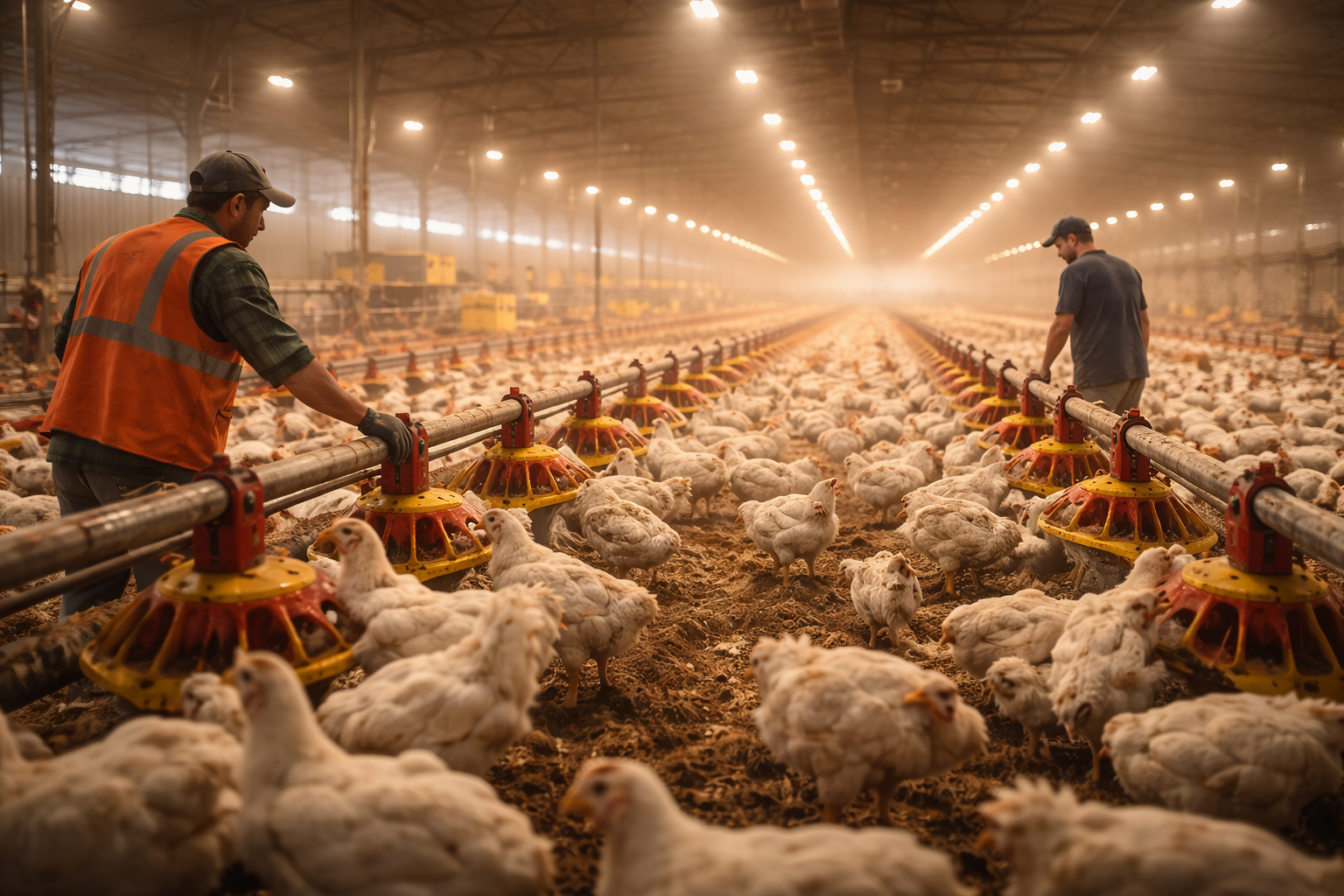
Earnest’s near-term view remains positive on volumes. He said chicken continues to be the fastest-growing protein in the US market, and that production is expected to increase by around 2% in 2026, with broiler output nearing 9.4 billion head. Softer feed costs are helping, but the operating environment is still shaped by labour availability, higher capital costs, and breeder supply challenges.
The sector response, Earnest said, is a continued move away from commodity-style production toward tighter specialisation. In processing terms, that shows up in heavier birds, deeper further-processing programmes, and more technology on the floor to maintain throughput when headcount is difficult to secure. The same trend is being reinforced by shifting demand, with growing domestic interest in dark meat changing cut-out strategies and the economics of deboning and portioning decisions.
CoBank’s own analysis has also framed the current production model as increasingly dependent on “more pounds per bird” and value-added formats, rather than a wave of greenfield primary capacity. In a January Knowledge Exchange report, CoBank put annual per-capita chicken consumption at 103 pounds and estimated the US would produce more than 47.6 billion pounds in 2025 on a retail-weight basis. The report also pointed to fertility and hatchability issues at the parent level as a limiting factor on chick availability, alongside disease pressure, and an ageing hatchery base.
For processors, those upstream constraints translate into a narrower set of levers downstream: optimise yields, reduce rework, improve consistency, and automate the most labour-intensive tasks. Earnest’s comments at IPPE placed automation and further processing in the same bucket — not as optional upgrades, but as the mechanics of keeping supply moving through a system that has fewer slack resources than it did a decade ago.
The implication for 2026 is continued growth, but delivered through incremental efficiency gains, format shifts, and higher utilisation of existing assets, rather than an easy expansion story.