IN Brief:
- PSB Industries is highlighting moisture separators built for gas and air streams used in industrial processing, including food applications.
- The line combines centrifugal and demister or mesh designs, with aerosol removal ranging from 10 microns down to 0.3 microns.
- The announcement puts utility-side contamination control back into focus as food plants tighten compressed air and gas quality management.
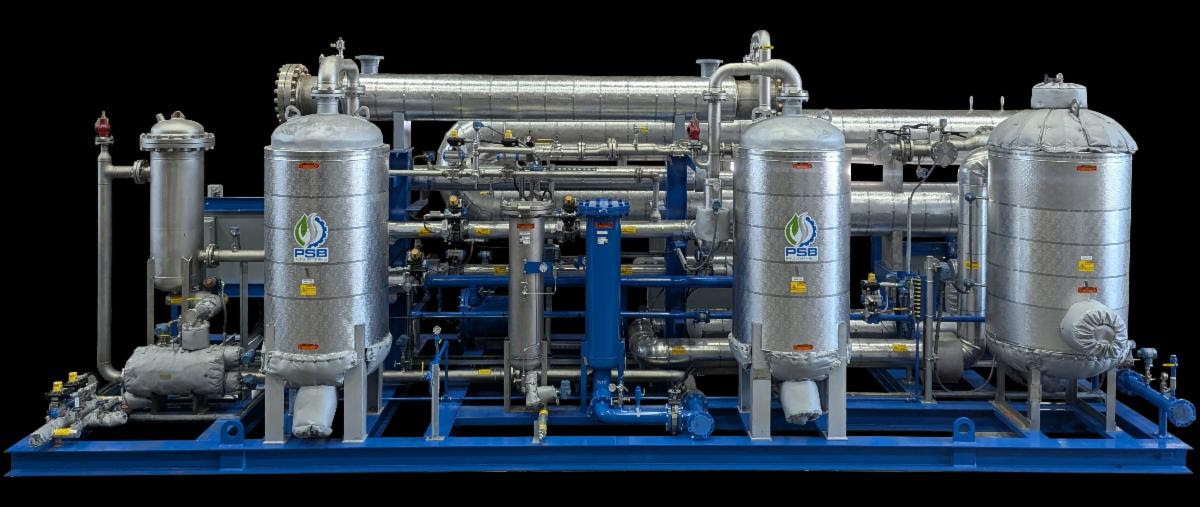
PSB Industries has highlighted its moisture separator range for industrial gas and air treatment, setting out two main separator designs that can be applied where process-stream dryness and purity are critical to plant performance. Food processing is among the sectors identified for the systems alongside air separation, petrochemical, transportation, and other industrial uses.
The company’s range is split between centrifugal separators for higher-velocity gas flows and demister or mesh separators for lower-flow duties requiring finer aerosol capture. According to PSB, the centrifugal design removes aerosols down to 10 microns and does not require replacement of internal components, a configuration intended to reduce maintenance. The demister or mesh option can be configured for removal down to 0.3 microns, with permanent or replaceable internal mesh depending on the application.
For food and beverage sites, that kind of separation forms part of broader contamination control across compressed air and gas systems. Compressed air and process gases are routinely used in packaging, conveying, container drying, cleaning, and product handling, which means liquid water, oil aerosols, and unstable dew point performance can become both operational and hygiene issues if they are not controlled.
Industry guidance reflects that wider role. The British Compressed Air Society’s food and beverage best-practice guidance sets out installation, maintenance, auditing, and air-purity requirements intended to reduce contamination risk in processor systems. In practice, that places extra attention on pre-treatment, filtration, condensate management, and the match between separator design and flow conditions.
The separator range also connects with adjacent food-sector gas treatment duties. On its wider platform, the company markets oxygen-removal CO2 systems for uses including beverage-grade applications and product preservation, showing how moisture removal is often only one stage in a broader gas-purity train. For processors reviewing utilities, separator choice is closely tied to how the wider air or gas system performs under operating conditions.