IN Brief:
- Domino has introduced the Gx-Series PRO Printhead ahead of interpack 2026.
- The system is designed for larger, high-contrast 2D codes at industrial line speeds.
- Food coding is becoming more closely tied to traceability, verification, recalls, and data control.
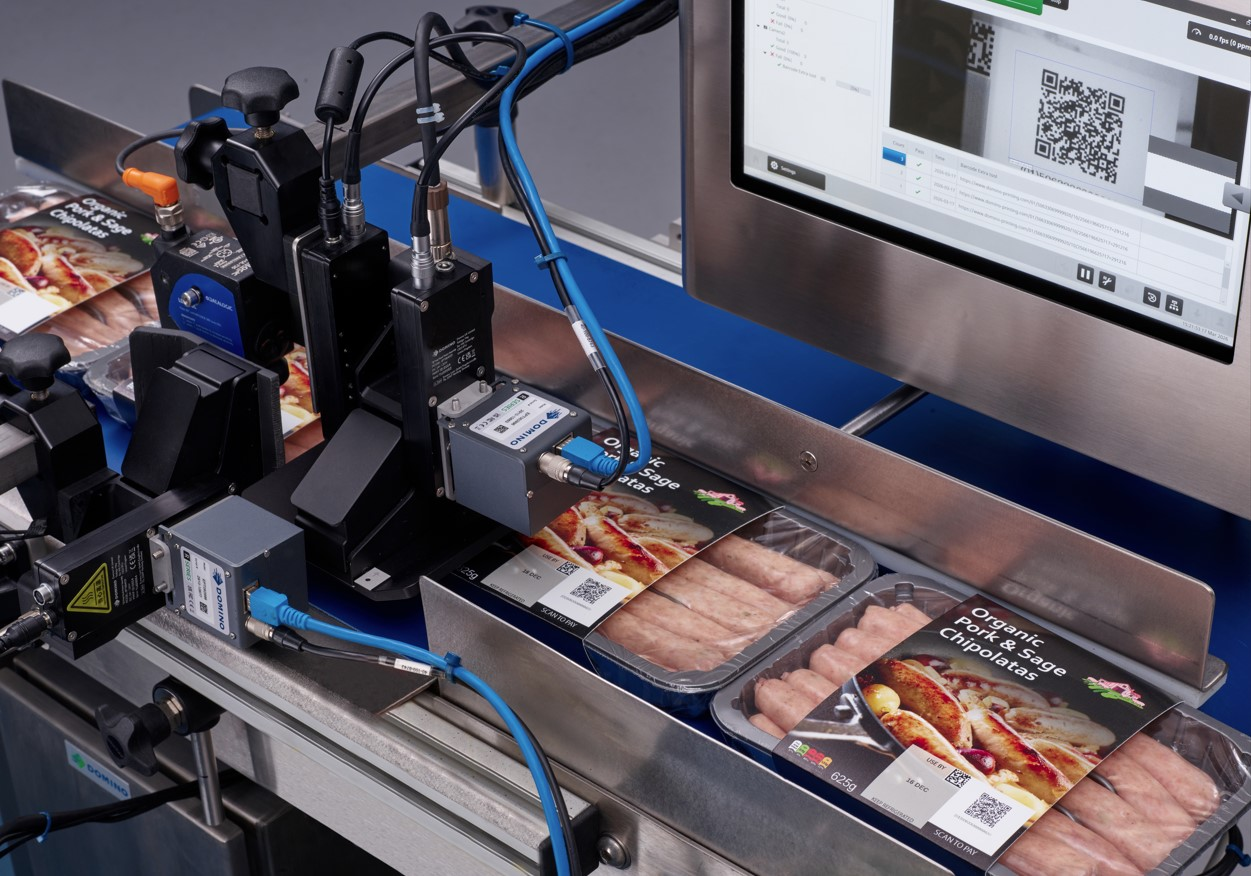
Domino Printing Sciences has launched the Gx-Series PRO Printhead ahead of interpack 2026, targeting manufacturers preparing for the move to GS1 Digital Link and variable 2D codes. The thermal inkjet system has been developed for applications that require larger print areas, high optical density, high resolution, and reliable performance at line speed.
The launch lands at a point when coding is becoming more demanding for food manufacturers. A date code and batch number printed clearly on pack has long been treated as a functional necessity. The shift to 2D changes that. Once a code starts carrying richer information for retail systems, traceability, recall handling, stock control, and consumer-facing applications, the printing task becomes part of a broader operational chain.
Domino is positioning the Gx-Series PRO accordingly. The printhead has a 23 mm print height and is aimed at high-throughput packaging lines, including fresh and chilled foods such as meat, fish, and poultry, as well as direct-to-box applications. The company is also framing the system around three production priorities: waste reduction, speed, and compliance.
Those priorities reflect the pressure points on modern food packaging lines. A poor code is no longer just a legibility problem. It can interrupt downstream scanning, complicate retailer acceptance, undermine traceability, and create waste through rework or rejected packs. Larger 2D codes, printed clearly and verified in line, are becoming essential where manufacturers want to support expiry checks, automated stock handling, or faster recall processes.
Domino’s argument rests on the system around the printhead as much as the printhead itself. Combined with Domino Automation and the R-Series smart vision system, the Gx-Series PRO becomes part of a closed process that links code creation, print management, inline verification, and exception handling. That kind of integration is increasingly important as manufacturers move from simple printed marks to data-rich codes that must be correct every time.
Food plants have managed coding for years, but the structure around it is changing. Artwork control, message management, scanner performance, and code verification are becoming more tightly connected. The transition to 2D coding exposes weaknesses that were easier to live with in a 1D environment, where less data was being carried and less depended on every scan working first time. Once more information is embedded in a symbol, errors travel further and become harder to dismiss as a minor packaging issue.
The food sector has particular reasons to move carefully but quickly. Fresh and chilled categories place heavy demands on line speed and pack handling, while traceability expectations remain high. Any change in coding equipment can touch quality assurance, packaging specification, IT, and retailer compliance at the same time. That makes reliable print performance necessary, but not sufficient. Manufacturers also need strong control over the data entering the code and clear visibility of how those codes perform on the line.
Ink development is part of that equation. Domino says it is developing water-based and solvent-based food packaging compliant inks and is manufacturing food packaging inks in accordance with EuPIA GMP. For food producers qualifying new coding setups across multiple substrates and environments, those details are central to adoption. The printer may attract the first conversation, but compliance work usually decides how quickly a system moves into production.
The wider 2D transition is reshaping the coding market. Packaging lines are being asked to support more information without slowing down or adding avoidable complexity. Retailers want better scanning and richer product data. Manufacturers want tighter recall control and stronger verification. The pack itself is becoming a more active carrier of operational data, and that changes the role of coding equipment on the line.
Suppliers that can link print, inspection, and data management into one controlled system are likely to benefit as those requirements tighten. The days when coding could sit quietly at the edge of the line, noticed only when a mark failed inspection, are coming to an end. For food manufacturers planning their next equipment and compliance cycle, 2D readiness is starting to look less like a future project and more like an immediate packaging decision.