IN Brief:
- A leading UK flour mill has replaced an older palletising operation with a high-speed robotic system from Endoline Robotics.
- The installation handles both flour bundles and individual packs across two production lines, with automatic tool changes via the HMI.
- End-of-line automation is becoming more important in milling as product ranges widen and pack-format complexity increases.
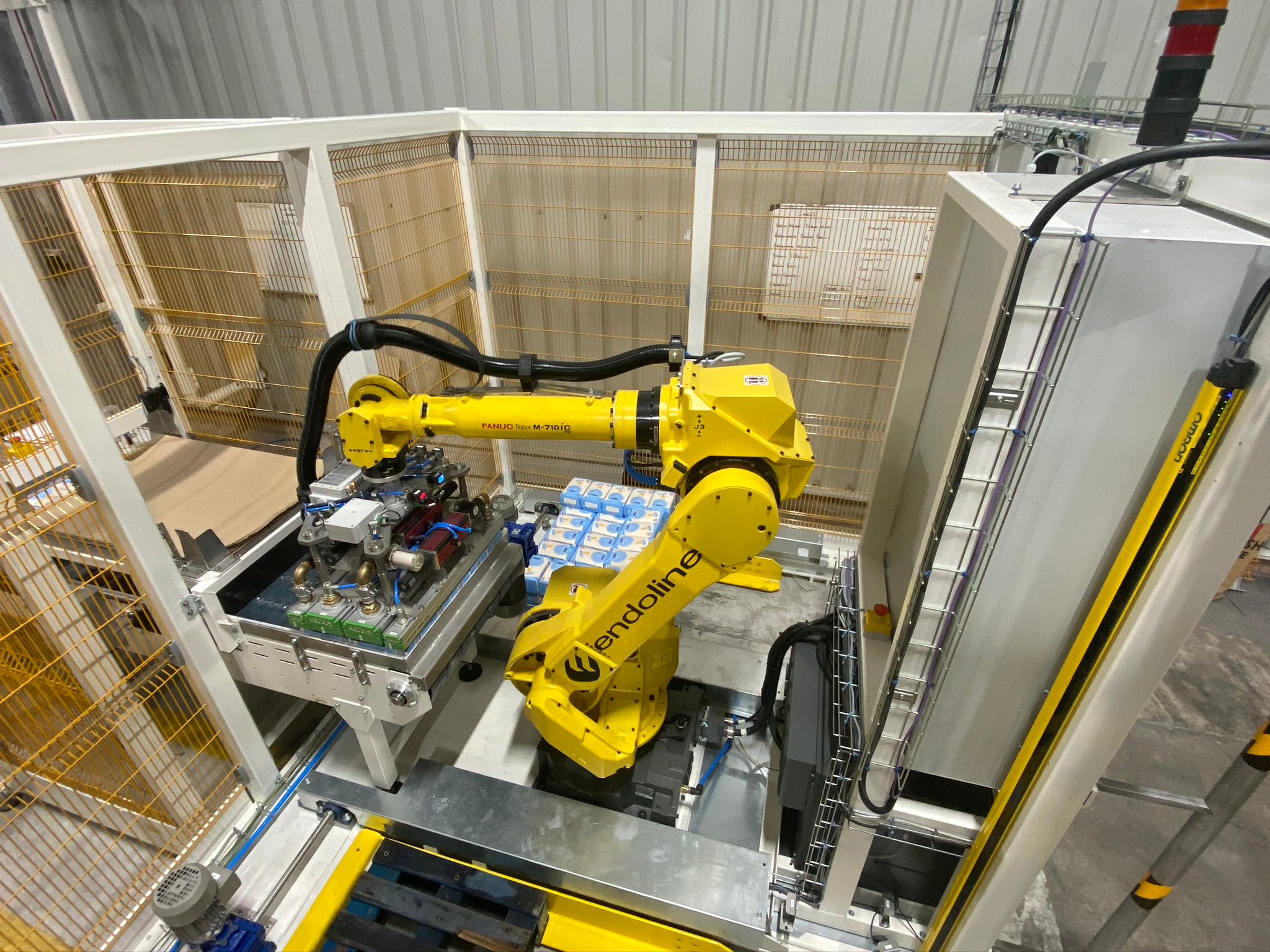
Endoline Robotics has installed a new high-speed palletising and conveyor system at a leading UK flour mill, replacing an older operation that no longer matched the site’s growing throughput and format requirements. The new system is designed to work alongside an existing Endoline palletiser already dedicated to one of the mill’s two production lines, extending the site’s wider automation programme rather than starting from scratch.
The flour mill runs two filling lines producing both individual 1 kg and 2 kg retail bags and larger 18 kg shrink-wrapped bundles. Under the previous arrangement, one existing palletiser handled individual bags from Line 1, leaving Line 2’s individual bag output and the bundled output from both lines to be managed by a less adaptable system. As product formats expanded and customer requirements diversified, the older palletising arrangement became harder to run efficiently.
The replacement installation has been engineered to handle both product streams. Bundles from the two lines can be conveyed at up to 14 per minute per line, giving a combined capacity of up to 28 bundles per minute, while individual 1 kg to 2 kg bags from Line 2 can be fed at rates of up to 70 bags per minute. The line also includes automatic handling and placement of wax paper interlayer sheets, helping support load stability further downstream.
Product moves through a network of accumulation and transfer conveyors designed to maintain steady flow into the palletising area without interrupting upstream filling and packing. The system can manage simultaneous pick-up of bundled products from both lines, while a re-tooling function allows it to switch to palletising individual flour packs fed via the centre conveyor. Endoline says the tool change is carried out automatically through the HMI, with the robot docking its current end-of-arm tool and connecting to an alternative one for controlled changeover between formats.
In flour milling, the end of the line can quickly become the limiting factor when pack variety increases. Throughput on the filling side only translates into shipped product if palletising, load building, and transfer can keep pace. Mills that once ran more repetitive output patterns are now often dealing with a wider mix of pack sizes, customer configurations, and scheduling changes. That puts greater pressure on the flexibility of palletising and conveying systems, especially where older equipment was designed around narrower product assumptions.
The labour profile is changing as well. Manual or semi-manual handling at the end of the line can add strain, variability, and disruption at the point where finished goods need to move smoothly into storage and distribution. Better automation helps reduce that variability while improving pallet consistency and handling quality. For staple categories such as flour, those gains are often more valuable than they first appear because the category depends on dependable, high-volume output rather than high-margin complexity.
The mill has already worked with Endoline before. In 2020, the company supplied a robotic palletising system at the site to help support a sharp increase in retail flour demand during the pandemic, enabling production of more than 167,000 bags per week. The latest project builds on that earlier phase and shows how automation in milling is often introduced step by step, with each installation tackling a different pressure point as output, product mix, and customer expectations evolve.