IN Brief:
- Amcor, Metsä Group, and G Mondini have created a fibre-based tray system for chilled food applications.
- The solution combines a fibre tray, barrier liner, and top web.
- It is designed for protein and chilled ready meal lines, with live machine demonstration at interpack.
Amcor, Metsä Group, and G Mondini have collaborated on a fibre-based tray system designed for protein and chilled ready meal applications.
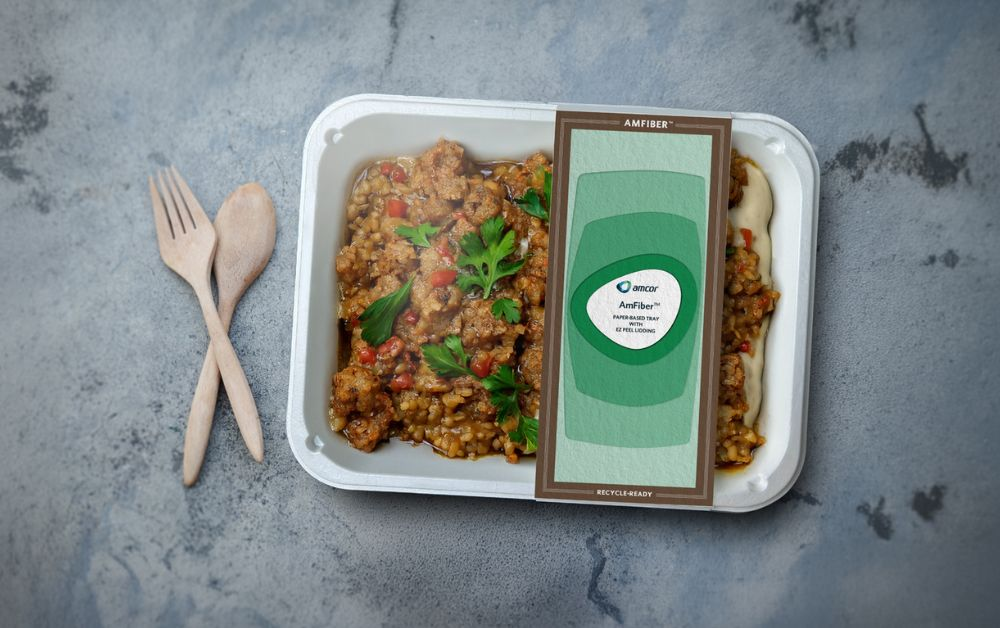
The system combines a lightweight barrier liner and top web with a fibre-based tray, giving food manufacturers and packers an integrated route into fibre-based formats for perishable chilled products. The solution is due to be demonstrated at interpack 2026 in Düsseldorf, where it will run live on G Mondini’s Trave Streamline machine from 7–13 May.
The tray uses Muoto, a moulded fibre packaging solution developed by Metsä Spring, Metsä Group’s innovation company. The fibre base is made from renewable wood sourced from northern forests, while Amcor’s barrier and top-web films are designed to provide product protection across different chilled food applications.
The system has been engineered to reduce plastic use while supporting shelf-life performance. It can also include convenience features such as microwaveability, oven suitability, and easy-peel functionality, depending on product and pack requirements.
Fibre-based tray systems have historically faced a practical barrier: material substitution only works if the tray, liner, lidding film, seal, and machinery operate together. A tray that performs well on material metrics will not gain industrial traction if it slows line speed, weakens seal integrity, increases rejects, or narrows the product’s shelf-life window.
The involvement of G Mondini gives the system a stronger production footing. Live operation on established tray-sealing equipment provides evidence of how the format behaves under heat, pressure, throughput, product load, and commercial packing-line conditions.
Chilled ready meals and protein packs are among the more demanding categories for fibre packaging. Products often require moisture and grease resistance, reliable sealing, chilled-chain durability, and consumer-friendly opening. Meat, fish, poultry, and prepared meals also need packs that protect visual quality, control leakage, and maintain shelf presence.
The project aligns with European packaging policy pressure around recyclability, plastic reduction, and fibre-based alternatives. Food manufacturers are looking for lower-plastic formats that do not require major plant reconfiguration, making machinery compatibility central to adoption.
Fibre systems still carry technical trade-offs. Barrier coatings, recycling streams, food-contact performance, and end-of-life clarity all need to be managed. The strongest formats are those developed as complete packaging systems rather than single-material substitutions.
Amcor, Metsä, and G Mondini are targeting that systems challenge by combining tray material, barrier technology, top web, and machine integration. The interpack demonstration will provide the first major industrial showcase for the format.
Reliable machine handling and pack performance could give chilled food producers a more practical route into fibre-based tray formats, particularly in categories where sustainability pressure is rising but shelf life and seal quality remain non-negotiable.