IN Brief:
- The 2026 European Reuse Barometer surveyed 113 businesses and organisations, with 77% reporting scale-up or in-market operations.
- Eight of 11 business-to-business respondents report packaging return rates above 95%.
- Some 95% of responding companies plan to recruit within two years, although their approximately 690 projected jobs remain intentions rather than completed appointments.
New ERA and Zero Waste Europe have launched the 2026 European Reuse Barometer, recording high packaging return rates among participating businesses while identifying continuing economic, regulatory and infrastructure constraints on the expansion of reusable packaging systems.
The third edition draws on responses from 113 participants operating in reuse and refill markets. Among those surveyed, 77% report being at the scale-up or in-market stage, while 62% describe themselves as fully in-market. These figures reflect the participating organisations rather than the proportion of the entire European packaging market served by reuse.
Return performance is particularly strong among some established business-to-business systems. Eight of the 11 respondents in that category report return rates above 95%, while seven of eight consumer-facing businesses using penalty-based or hybrid return mechanisms report rates exceeding 90%.
The small number of respondents in each group limits the extent to which these results can be generalised. They nevertheless provide evidence that particular operating models can recover a high proportion of packaging placed into circulation when collection and return arrangements function effectively.
Reusable packaging systems depend on recovering containers after use and preparing them for subsequent filling, storage or distribution cycles. Depending on the application, returned packaging may require sorting, inspection, washing, reconditioning and transport before it can be used again.
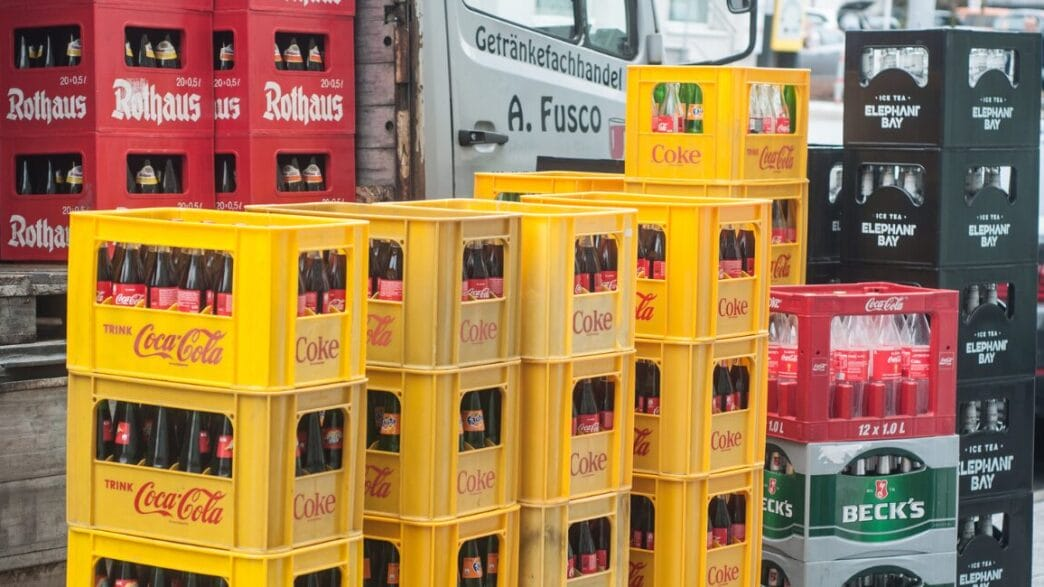
The equipment and infrastructure needed for those operations differ according to the packaging format. Industrial transport crates, beverage bottles and consumer takeaway containers have different requirements for handling, hygiene, durability and identification, making direct comparisons between their operating costs difficult.
Business-to-business transport packaging often moves through relatively established commercial networks. Containers may circulate between manufacturers, distribution centres and other known facilities, with collection responsibilities and operating procedures defined through contracts or shared arrangements.
Consumer-facing systems generally involve a wider range of return locations and user behaviour. Packaging may be retained by customers, returned to a different participating outlet or lost from circulation, increasing the need for convenient collection points and effective asset management.
The Barometer identifies deposit and penalty-based arrangements among the mechanisms associated with higher returns. Their performance depends on the design of the scheme, the financial incentives involved and the accessibility of collection infrastructure.
Packaging return rates influence manufacturing economics because the initial cost of a reusable container must be distributed across repeated cycles. When containers complete sufficient rotations, their material and manufacturing costs can be spread over more uses, although each circulation cycle introduces additional operating requirements.
Those requirements may include reverse transport, handling, washing, inspection, storage and the replacement of damaged or missing containers. The commercial result depends on the balance between the number of successful uses and the resources consumed to support them.
A high return rate can reduce replacement demand but does not by itself establish environmental or economic superiority over a single-use alternative. The weight and material composition of the packaging, transport distances, cleaning processes and number of completed rotations all affect its performance.
Manufacturers adopting reuse must also consider compatibility between the container and their production equipment. Filling lines, conveyors, case packers and inspection systems may need to accommodate packaging that has previously been used, creating requirements for dimensional consistency and rejection of unsuitable containers.
In food applications, a returned pack must remain suitable for its intended contact with the product. Cleaning procedures require validation against the relevant contamination risks, while inspection systems must identify damage, residues or other conditions that could affect packaging performance.
Standardisation can help operators consolidate return and cleaning volumes. Shared container dimensions and suitable material specifications may allow several businesses to use common collection infrastructure, washing equipment and transport arrangements rather than operating completely separate systems.
The commercial feasibility of such arrangements depends on the participating products and distribution networks. Packaging intended for one type of food or filling process may not be compatible with another, and hygiene requirements can limit the extent to which different applications can share infrastructure.
The 2026 Barometer identifies policy and economic conditions as leading concerns among respondents seeking to expand. Businesses point to stronger regulation, changes to extended producer responsibility arrangements and measures intended to reduce the financial disadvantage of reuse compared with single-use packaging.
Suggested measures include taxes on selected single-use packaging applications where reusable alternatives are available, alongside financial support for reuse and bulk distribution. These are proposals reported by participating businesses rather than measures established for implementation across Europe.
Relationships with extended producer responsibility organisations remain uneven. Approximately half of respondents describe their relationships positively, while others report limited contact, uncertainty or unsatisfactory engagement with the relevant schemes.
Those relationships can influence the financing and organisation of collection systems. A reuse operator establishing a new network may require investment in containers, collection points, washing facilities and tracking technology before the system reaches a volume capable of supporting its operating costs.
Employment expectations indicate that respondents anticipate further activity. Some 95% plan to recruit within the next two years, collectively projecting approximately 690 additional roles. These are hiring intentions and cannot be treated as jobs already created or guaranteed by the research.
The associated work could involve packaging production, cleaning, equipment maintenance, logistics, digital asset tracking and other operational functions. The eventual number and distribution of positions will depend on investment, commercial adoption and the operating models selected by participating companies.
The Barometer has also expanded its research platform to provide access to company information, case studies and sector evidence. The 2026 findings are scheduled for presentation at the Sustainable Packaging Summit in Utrecht on 11 November.
European packaging regulations provide a developing framework for reuse, but individual systems still need to demonstrate that their operational arrangements are technically and commercially sustainable. The survey's high return figures illustrate what some participating businesses have achieved, while the wider findings identify the investment and coordination still required to expand those models.
Further growth will depend on collection networks capable of maintaining returns as volumes increase, suitable industrial cleaning and inspection capacity, and commercial arrangements that distribute costs across participating businesses. The next measurable indicator will be whether established high-performing systems can expand without losing the operating characteristics that currently support their return rates.