IN Brief:
- Eberle Automatische Systeme has developed an automated cheese-ripening inspection system using MVTec machine vision software.
- The setup combines a mobile care robot, 4K imaging, deep-learning inspection and digital monitoring to detect defects earlier.
- The project points toward broader automation of ripening, traceability and quality control in cheese production.
AI and machine vision are moving further into dairy quality control, with a new cheese-ripening application showing how inspection can be automated inside one of the most variable stages of production. Developed by Eberle Automatische Systeme using MVTec’s HALCON software, the system has been deployed for cheese maker Gebr. Baldauf to monitor and manage wheels during maturation.
The technical challenge is clear. Cheese ripening can last for up to 14 months, and maintaining consistent quality across large volumes requires repeated inspection for mould, cracks, discolouration and other surface defects. Manual checking becomes harder to scale as throughput rises, particularly in production environments where labour availability remains tight.
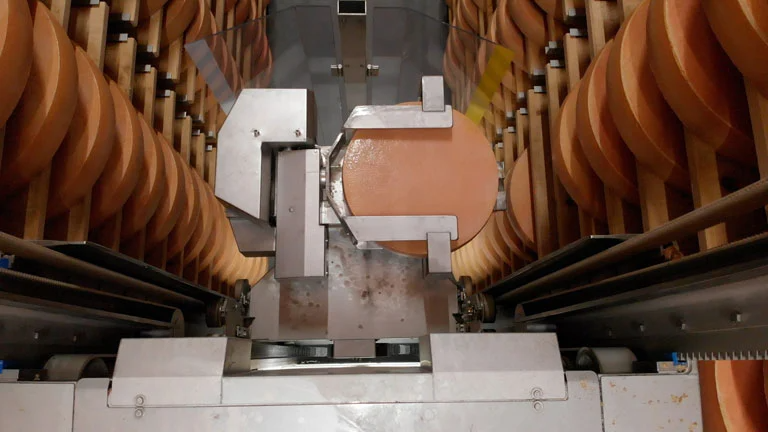
Eberle’s approach combines a mobile care robot, 4K cameras and onboard image processing. As the robot handles cheese during ripening, images are captured and analysed using deep-learning tools within HALCON. The system then flags anomalies and feeds the results into a web-based interface for monitoring and control, while the robot also carries out routine care tasks such as treating the cheese surface and removing unwanted smear layers.
That combination shifts the role of inspection from periodic sampling toward continuous and standardised assessment, with earlier defect detection and a digital record of what has been observed on each wheel. MVTec said the result is full inspection coverage using consistent criteria, alongside improved traceability and a stronger basis for longer-term process optimisation.
The deeper technical issue is variability. Cheese does not present like a uniform industrial part, and rule-based machine vision can struggle where each wheel changes differently over time. That is why deep learning sits at the centre of the system, allowing trained models to distinguish between natural variation and genuine defects over extended ripening periods.
The project is now being positioned as a platform for broader rollout. Eberle said the next step is to refine the models across different cheese types and ripening stages, and to integrate the approach into both mobile and stationary care robots. That would move the system beyond a single application and closer to a repeatable ripening automation model for dairies seeking tighter quality control without scaling manual inspection alongside output.