IN Brief:
- Kerry has expanded its Carrigaline site to raise industrial-scale lactase output for dairy processing.
- The project links enzyme engineering, strain development, and production more closely across Kerry’s biotech network.
- The investment reflects stronger demand for lactose-free and reduced-sugar dairy without sacrificing taste or throughput.
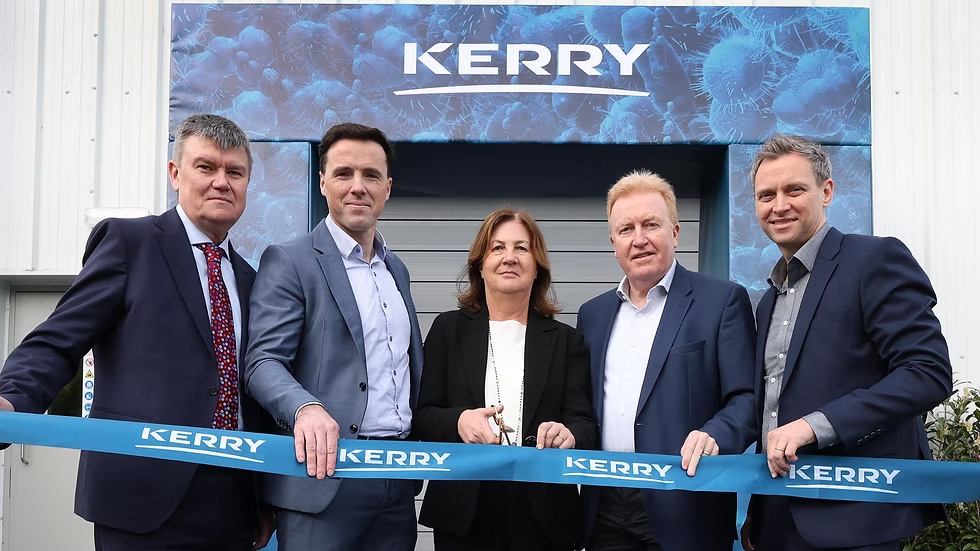
Kerry has opened an expanded biotechnology manufacturing facility in Carrigaline, County Cork, adding fresh industrial capacity for lactase enzyme production as dairy processors accelerate work on lactose-free and reduced-sugar lines. The site forms part of Kerry’s wider enzyme network and is intended to tighten the connection between R&D, strain development, application support, and full-scale manufacturing.
The Carrigaline expansion is aimed squarely at one of the more durable growth pockets in dairy processing. Lactase is no longer a niche tool reserved for specialist products. It now sits at the centre of mainstream production strategies spanning lactose-free milk, cultured dairy, ambient formats, and products that also use enzyme systems to unlock sweetness from lactose and reduce added sugar. In that context, extra manufacturing headroom is not just a capacity story. It is a response to a category where formulation, process stability, and speed to market increasingly move together.
Kerry said the site already supports a broad international customer base and plays a central role in supplying enzymes used in the processing of more than two million tonnes of milk each year. The expanded facility is designed to make that support more resilient, while helping processors move more quickly from pilot and application work into commercial production. That matters at a time when dairy manufacturers are being pushed in several directions at once: lower sugar, broader tolerance claims, stable sensory performance, and cleaner, more efficient scale-up.
For processors, the practical value sits in execution. Lactase use can affect sweetness development, process timing, product consistency, and downstream formulation choices. A supplier with more production depth and stronger application support is better placed to help manufacturers manage those variables rather than simply ship an ingredient and step away. Kerry’s emphasis on linking Carrigaline with its Global Innovation Centre and biotechnology capabilities in Leipzig suggests the company sees the competitive advantage in that integrated model rather than in commodity enzyme volume alone.
The timing is also notable. Dairy producers are under pressure to keep reformulation costs under control while still responding to demand for products positioned around digestive comfort and reduced sugar. Lactose-free used to mean a narrower premium segment. It is now edging closer to a standard option in several markets, especially where retailers want broader access, longer line extensions, and fewer compromises on taste. That shift places more weight on dependable industrial supply, especially when processors are launching across regions or adding multiple SKUs at once.
There is also a wider manufacturing angle for Ireland. Carrigaline’s expansion reinforces the country’s role as a base for high-value food and biotechnology production, not just bulk output. The more enzyme, culture, and specialist processing technologies cluster around established dairy infrastructure, the more attractive that ecosystem becomes for future investment. That does not remove the pressure on energy, labour, or operating costs, but it does make the strategic case for keeping advanced food manufacturing capability close to established milk pools and technical expertise.
The second half of the year is likely to show whether more suppliers follow the same path. Processors are looking for ingredients that come with process knowledge, regulatory familiarity, and supply continuity, not just sales coverage. In dairy, that is becoming especially true in categories where nutritional positioning and line efficiency now overlap. Kerry’s move in Carrigaline speaks to that reality: enzyme supply is no longer a back-room procurement issue, but part of how processors build margin, speed, and product credibility into the next round of dairy innovation.