IN Brief:
- Anabtawi Food Industries has inaugurated an AED150m ice cream factory occupying more than 172,000 sq ft at Dubai Industrial City.
- Flexible production lines have stated capacity exceeding 45 million litres annually, with formats ranging from 10ml portions to 10-litre tubs.
- The FSSC 22000-certified facility supports private-label and co-packing operations, with an expected 450 jobs and a temperature-controlled distribution network.
Anabtawi Food Industries has inaugurated an AED150m ice cream manufacturing facility at Dubai Industrial City, adding production capacity for its own brands and contract manufacturing customers across the United Arab Emirates and regional export markets.
The factory covers more than 172,000 sq ft and contains flexible, custom-engineered production lines with stated capacity exceeding 45 million litres annually. The investment is expected to support approximately 450 new jobs as the operation develops.
Production will serve the company's MiniMax ice cream brand alongside private-label and co-packing customers. Anabtawi intends to use the Dubai facility as an export base for Gulf Cooperation Council countries and the wider Middle East and North Africa region.
The production lines can accommodate formats ranging from 10ml individual portions to commercial tubs holding 10 litres. This breadth of packaging sizes allows the facility to address different customer requirements, although Anabtawi has not identified individual production-line speeds or the proportion of capacity allocated to each format.
Manufacturing flexibility is important to the planned operating model because branded products and contract manufacturing arrangements may require different recipes, portion sizes and packaging specifications. A factory supplying several customers must also maintain records and controls that associate each production run with the correct product and materials.
Ice cream manufacture involves a sequence of processing operations in which formulation and temperature control influence the structure of the finished product. Ingredients are combined into a mix before undergoing suitable treatment, homogenisation and ageing, followed by freezing and subsequent handling appropriate to the product.
During freezing, the product develops its characteristic structure through the formation of ice crystals and the distribution of fat and air within the mix. The process conditions influence the resulting texture, while formulation determines how the product behaves during freezing, storage and consumption.
Industrial operations must maintain the required conditions across successive production batches. Differences in ingredient characteristics, processing temperatures or operating settings can change the physical properties of the product, making monitoring and control important when manufacturing consistent commercial ranges.
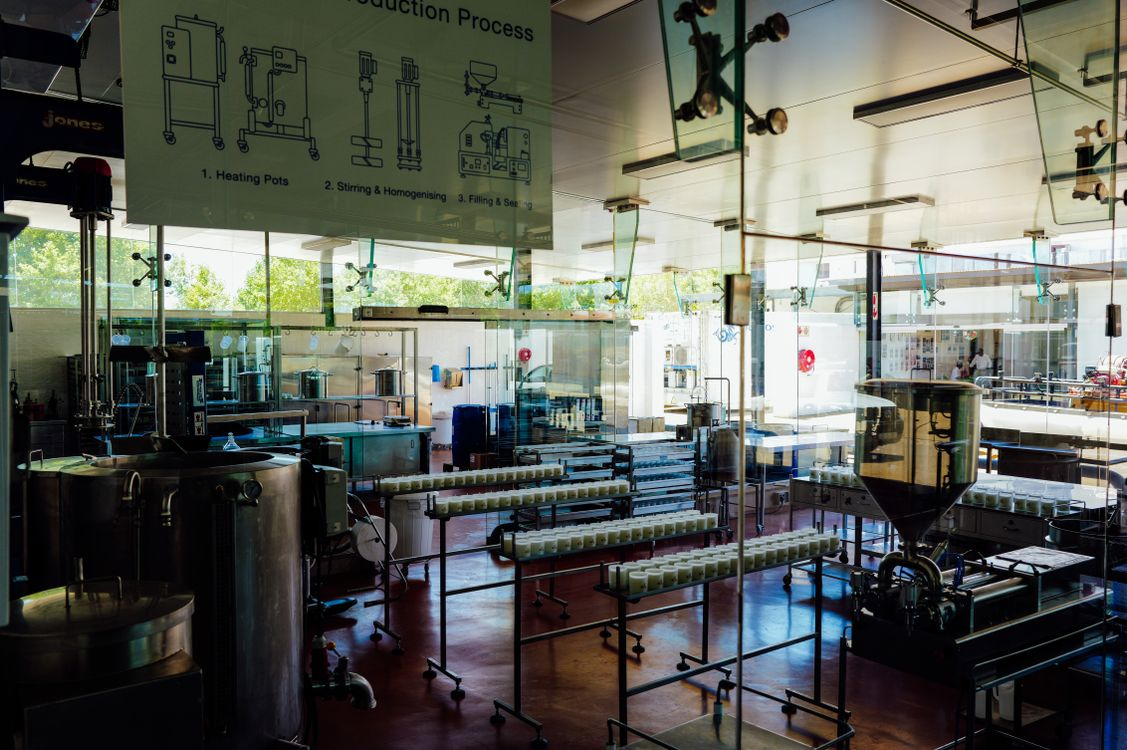
Small individual portions introduce different production requirements from larger tubs. Handling equipment must accommodate the selected container dimensions, while filling and packaging systems need to deliver the specified quantity without compromising hygiene or the integrity of the finished pack.
Further complexity can arise where products contain coatings, layered ingredients or inclusions. Such formats may require additional processing and handling stages, although Anabtawi has not disclosed the particular equipment configurations used for its various product ranges.
The factory's stated annual capacity provides an indication of the scale of the installed operation. It should not be confused with the quantity currently being manufactured, which will depend on orders, operating schedules, staffing and equipment utilisation.
Anabtawi has not published its expected first-year production volume or a detailed timetable for increasing output. The available figures establish the design capability of the facility rather than a confirmed production rate already achieved.
Food safety controls form another part of the operating arrangements. The new factory holds FSSC 22000 certification, which provides a recognised framework for food safety management within the applicable certification scope.
Certification does not replace the need for routine production controls. Manufacturing hygiene, equipment cleaning, ingredient management and verification procedures must remain suitable for the products produced and the activities carried out within the facility.
Where a site manufactures products for several customers, the production system must also manage recipe changes and ingredient identification. Different products can present different allergen and cleaning requirements, while packaging and labelling must remain consistent with the relevant specification.
The new facility is supported by a refrigerated distribution network. Anabtawi operates a dedicated fleet of vehicles designed to maintain temperatures below –18°C, together with cold storage hubs across the UAE.
Temperature control is particularly important for frozen desserts because changes during storage and distribution can affect their physical structure. Partial warming followed by refreezing can encourage the growth of ice crystals, with potential consequences for texture and appearance.
Maintaining suitable conditions requires coordination beyond the vehicle refrigeration system. Loading operations, storage temperatures, transfer times and the movement of products between facilities must be managed so that the required conditions are maintained throughout the distribution process.
Production capacity also has to be matched by the ability to harden and store finished products. Increased filling capability cannot automatically translate into additional commercial output if frozen storage, downstream handling or dispatch arrangements impose constraints.
The factory's location at Dubai Industrial City provides access to an established industrial district developed by TECOM Group. The site is close to Jebel Ali Port and Al Maktoum International Airport, with an Etihad Rail freight terminal serving the wider industrial area.
These connections provide options for moving ingredients, packaging materials and finished products through regional and international logistics networks. The company has not disclosed the specific transport routes or modes it intends to use for individual export markets.
The development also adds to the food and beverage manufacturing capacity established within Dubai Industrial City. The district forms part of wider UAE industrial development plans, including initiatives intended to expand domestic production and attract investment in manufacturing activities.
Anabtawi chairman Zahi Anabtawi has identified the ability to supply different product formats and develop partnerships with distributors and retailers as priorities for the new operation. The facility's flexible lines are intended to support those commercial arrangements without requiring a separate factory for every product format.
Customer qualification will determine how the new capacity is used. Private-label and co-packing arrangements require agreement on product specifications, manufacturing procedures, quality requirements and delivery conditions before commercial volumes can be established.
With the factory inaugurated, future operating results will indicate the extent to which the stated capacity is utilised. The company has not disclosed committed export volumes or the number of private-label customers already contracted, leaving production ramp-up and commercial order development as the next measurable milestones.