IN Brief:
- Barentz has opened a Human Nutrition application laboratory and new office in Shanghai.
- Initial application work will concentrate on bakery and savoury formulations.
- The site joins a global technical network supported by more than 40 food application specialists.
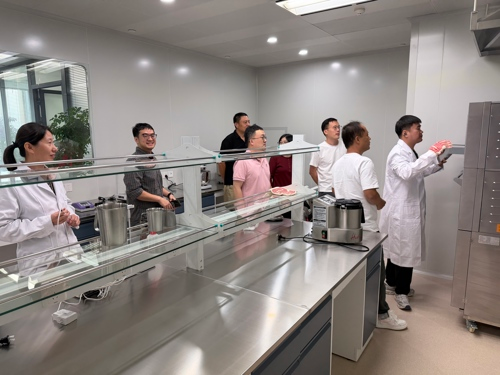
Barentz has opened a Human Nutrition application laboratory and new office in Shanghai, adding local formulation and technical service capacity for Chinese food manufacturers and initially concentrating the facility on bakery and savoury applications.
The laboratory will support ingredient testing, formulation work, and product development for customers and principal suppliers rather than operating solely as a commercial office. Barentz says the site will connect with its wider Asia Pacific and global technical network, allowing projects developed in China to draw on specialist knowledge from other application centres.
The initial bakery and savoury focus gives the site a clear production remit. Both categories depend heavily on ingredient interactions, with starches, hydrocolloids, proteins, emulsifiers, fibres, flavours, fats, enzymes, and stabilising systems capable of altering dough handling, water management, texture, process tolerance, shelf life, and sensory performance.
Barentz identifies modified starches and stabiliser systems among the capabilities relevant to the Shanghai operation. These materials rarely behave as simple substitutes inside a finished formulation. A starch that performs predictably under one combination of heating, shear, cooling, pH, and solids content may behave differently when any of those process conditions changes.
Application laboratories give ingredient distributors a means of testing those interactions before a customer commits factory time. Manufacturers can examine the effect of an ingredient in a representative finished product, identify basic compatibility problems, and establish a starting formulation before moving to a production scale trial.
Sue Song, vice president Human Nutrition APAC at Barentz, said customers increasingly require “technical expertise, formulation support, and faster innovation” alongside ingredient supply. The Shanghai investment places that capability closer to customers and principal partners in China.
The laboratory joins a broader Human Nutrition network supported by more than 40 application specialists. Their work covers bakery, beverages, health and nutrition, savoury products, dairy, meat and fish, plant proteins, and other food categories, giving the Shanghai operation access to technical expertise beyond its initial local focus.
Barentz already has a substantial business in China. The company says it supports more than 2,000 customers with over 130 employees, a network of offices, an existing application laboratory in Tianjin, and a 9,000 square metre storage facility. Shanghai therefore expands an established technical and distribution operation rather than creating one from scratch.
The company’s wider model combines ingredient distribution with formulation support, application centres, warehousing, sourcing, and local commercial teams. That places it between ingredient producers and manufacturers that need those materials to perform reliably inside finished products and established factory processes.
That intermediary role has become more technically demanding as food companies reformulate around cost, nutrition, label requirements, raw material availability, texture, and regional consumer preferences. A relatively small ingredient change can alter mixing, pumpability, baking behaviour, deposition, viscosity, cooling, storage stability, or packaging performance.
Local testing can remove part of that risk before a factory trial. Bench and pilot work cannot reproduce every industrial condition, but it can reject unsuitable formulations early, generate comparative data, and reduce the number of variables a production team has to investigate on live equipment.
The Shanghai location also gives Barentz a base for adapting global ingredient systems to regional applications. Bakery and savoury products vary significantly between markets in flavour, texture, process method, pack format, shelf life, and price point, so a formulation established elsewhere may need extensive adjustment before it fits Chinese production and consumer requirements.
Connection with the wider application network allows technical knowledge to be reused without assuming that identical formulations will transfer directly between regions. Existing data can provide a starting point, but final validation still depends on local raw materials, equipment, processing conditions, and finished product expectations.
Barentz has not disclosed the capital cost or floor area of the Shanghai facility, so the investment is better assessed through the capability being added than through conventional plant metrics. It is a technical development centre rather than a manufacturing expansion.
Its commercial performance will be reflected in project outcomes: fewer unsuccessful factory trials, quicker formulation decisions, and more ingredient concepts moving from laboratory work into repeatable production. The Shanghai laboratory adds another stage at which Barentz can influence that transition before manufacturers commit full scale plant time and material.