IN Brief:
- Schreiber Foods plans to invest more than $267m in a new process cheese facility in Carthage, Missouri.
- Operations are expected to begin in 2028, with approximately 100 additional jobs planned.
- The investment extends a wider Carthage manufacturing expansion already under development.
Schreiber Foods plans to invest more than $267 million in a new process cheese manufacturing facility in Carthage, Missouri, adding capacity at a location where the company already employs more than 1,300 people and has another substantial production project under development.
The new facility is expected to begin operating in 2028 and create approximately 100 jobs. Schreiber says the investment will strengthen its process cheese capacity and support a global production network supplying retailers, foodservice businesses, distributors, and food manufacturers.
The announcement follows a separate Carthage expansion unveiled in December 2024. That project involved a $211 million, 168,000 square foot facility intended to increase process cheese capability, with construction mobilisation scheduled for January 2025 and completion initially targeted for 2027.
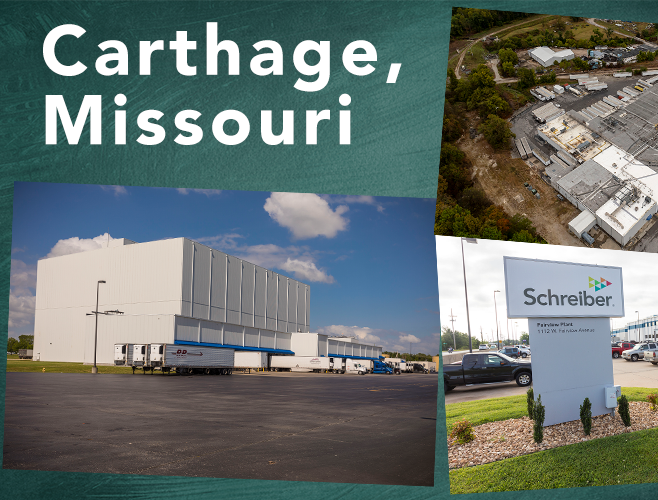
Schreiber’s existing Carthage footprint includes manufacturing facilities at Claxton Avenue and Fairview Avenue together with three distribution centres. The sites handle natural cheese, process cheese, cheese manufacture, and distribution, making Carthage an established production centre rather than a new market entry.
The additional $267 million commitment points to further demand for industrial process cheese capacity. Schreiber has not published line specifications, output tonnage, or an equipment package for the 2028 facility, so the scale of the capacity increase cannot yet be measured beyond the capital value and planned employment.
Process cheese requires a different production architecture from natural cheese manufacture. Cheese and other dairy ingredients are formulated, blended, heated, emulsified, and controlled to achieve specified melt, texture, moisture, flavour, and handling characteristics before the product moves into slicing, portioning, block forming, filling, cooling, or packaging.
Higher throughput can support several customer formulations while spreading utilities, laboratory work, maintenance, quality systems, and packaging infrastructure across a larger production base. It also increases the importance of scheduling and allergen control where a contract manufacturer is handling customer brand products with different recipes and formats.
Schreiber president Trevor Farrell said the investment would strengthen the company’s ability to deliver “quality, food safety, service and reliability” as customer requirements grow. Those measures are interconnected in process cheese production, where capacity is quickly eroded if formulation changes, cleaning, changeovers, inspection, or packaging losses reduce line availability.
The company has operated in Carthage since 1950, and the new plant extends a long concentration of manufacturing activity in the area. Schreiber employs more than 10,000 people globally and produces cream cheese, natural cheese, process cheese, beverages, and yoghurt across a network spanning five continents.
Distribution of capacity across several plants gives the business more options during maintenance shutdowns, demand peaks, ingredient constraints, or changes in customer mix. Moving a process cheese order between sites is not automatic, however, because equivalent formulation control, ingredient supply, packaging capability, and quality validation have to be available.
The latest project also adds to the labour requirement in Carthage. The earlier expansion was expected to create around 150 jobs, while the newly announced plant is associated with roughly another 100. Recruitment and training will have to progress alongside construction and commissioning if installed equipment is to reach planned utilisation after opening.
Automation reduces some manual handling but increases demand for technical capability in controls, refrigeration, hygienic systems, instrumentation, packaging equipment, and preventive maintenance. Commissioning a dairy plant therefore involves developing operators and engineering teams alongside validating recipes and production lines.
Utilities will be another important part of the project. Heating, cooling, refrigeration, clean in place systems, compressed air, water treatment, and packaging all have to be sized around the required output, while food safety controls have to be integrated from raw material intake through to finished product storage.
Schreiber has not yet provided a detailed construction timetable for the newly announced plant or clarified how its physical scope relates to the 168,000 square foot project already progressing in Carthage. Those details will determine whether the location is gaining two distinct production expansions or whether elements of the newer investment modify the earlier development programme.
More than $267 million is nevertheless a substantial commitment to additional process cheese production, particularly alongside the investment already under way. The next useful indicators will be construction progress, equipment installation, line capability, and the volumes Schreiber ultimately expects the Carthage operation to add from 2028.