IN Brief:
- Beatson Clark plans to invest more than £3.6m in four palletisers over 12 months.
- The equipment will support both standard UK and smaller Euro pallet formats.
- New screen printing lines and plant-wide air curtains broaden manufacturing capability.
Beatson Clark is investing more than £3.6 million in four new palletisers at its Rotherham glassworks, extending the plant’s ability to prepare bottles and jars for different distribution systems. The equipment is scheduled to be introduced over the next 12 months, with support for both standard UK pallets and the smaller Euro pallet format.
New screen printing machines have also been installed in the Rotherham decoration plant, while air curtains now protect operators undertaking hot end swabbing. These changes complement the palletising plan by expanding surface-finishing options, improving the handling of completed containers and reducing exposure to airborne particulates near forming equipment.
After inspection, bottles and jars have to be arranged into stable loads for warehouse storage and onward delivery. Pallet size determines the permitted load pattern, the amount of separation material and the interface with stretch wrapping, conveying and loading equipment. Beatson Clark’s investment will allow the packing operation to accommodate both standard UK pallets and the smaller Euro format specified by some customers.
Euro pallets are widely used in mainland European distribution, including within the network served by Beatson Clark’s sister company Pont Packaging. Preparing completed loads directly in the customer’s required format may remove a subsequent repalletising step. The benefit in any given shipment depends on container dimensions, load configuration and the receiving warehouse’s handling equipment.
Beatson Clark has already introduced a Euro palletiser at Rotherham. Beatson Clark also plans an investment of more than £3.6 million in four new palletisers during the next 12 months. The present installation demonstrates the use of both pallet formats, while the forthcoming programme is intended to extend that handling capability.
The manufacturer has operated on its Rotherham site since 1751 and supplies glass bottles and jars to food, beverage, pharmaceutical, homeware and personal care customers. Food is now its largest market, according to the company’s published profile. It reports annual production of approximately 605 million units, with an estimated production capacity of 105,000 tonnes.
Molten glass is formed into bottles and jars, then cooled under controlled conditions before inspection and packing. The palletising system receives inspected containers at the end of this process, where breakage prevention and stable load formation are essential. Its throughput has to accommodate the output of forming and inspection lines so completed containers can move into dispatch without causing accumulation upstream.
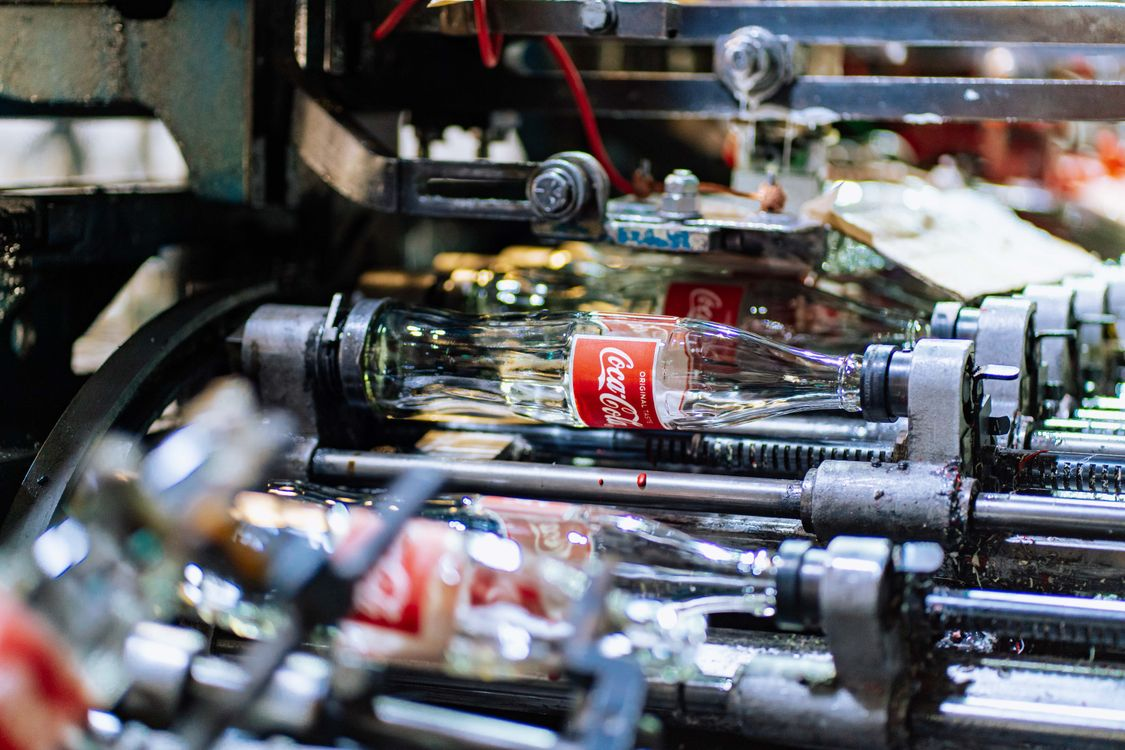
Beatson Clark’s decoration plant began operating in August 2024. New screen printing lines expand the effects that can be applied to containers, supplementing spray and other surface treatments. The company uses organic, ceramic and precious-metal inks to produce different appearances, with the finished specification depending on the intended brand and container application.
Ceramic inks are fused to the glass at elevated temperatures and are used where durable printed decoration is required. Organic inks provide a separate decorative option with different colour and processing characteristics. Integrating these services within the manufacturing operation offers an alternative to shipping undecorated bottles to another site before filling or distribution.
Screen printing adds another handling requirement because decorated surfaces must withstand subsequent contact, accumulation and transport without damage. Suitable container spacing, inspection and protective load formation can preserve the printed finish after it leaves the decoration line. Pallet format flexibility and expanded decoration capacity address different stages of that end-to-end handling sequence.
During hot end swabbing, operators work near equipment where contaminants can become airborne. The newly installed air curtains create a controlled airflow around the workstation that moves particulates away from the operator’s breathing zone. This is an engineering measure integrated into the process area, supplementing existing protective procedures and equipment.
The air curtain system was tested on one production line before being rolled out across the glassworks. Beatson Clark reports that real-time monitoring measured an approximately 95% reduction in airborne particulates in the operator’s breathing zone. That figure describes the monitored workplace exposure at those operations, not a change in total factory emissions.
The safety project has been shortlisted for a British Glass health and safety award, while the packaging investments coincide with Beatson Clark’s 275th year of manufacturing in Rotherham. The company remains part of Newship Group and positions its UK production and design operation around both standard container ranges and bespoke products.
Rotherham’s manufacturing operation includes separate white flint and amber glass furnaces, with forming equipment feeding container inspection and packing. The decoration plant, opened in August 2024, sits alongside that established capacity. Its expanded screen printing service allows customers to procure selected decorated containers from the same manufacturing business.
The four planned palletisers are due to enter the operation during the next 12 months. As they are commissioned, their principal function will be to accommodate different pallet specifications and maintain the flow of inspected glass containers into distribution, alongside the recently expanded decoration and operator-protection systems.