IN Brief:
- Cockerill is investing £1.65m as the volume of potatoes it supplies to Aldi continues to grow.
- Existing automation includes Key OCULUS optical sorting and LAN Technologies robotic end-of-line handling.
- Further projects will target packing, stacking, tray erection, and palletising while employees are trained to supervise automated systems.
Cockerill is investing £1.65 million in automation and operational improvements at its Yorkshire potato business, extending an established programme of optical sorting and robotic handling as volumes supplied to Aldi continue to increase.
The family-owned company operates from Dunnington near York and supplies fresh potatoes across bagged and loose formats. Its Aldi volumes have more than doubled since 2023, while the business currently supplies more than 16 million loose baking potatoes each year.
Cockerill says the growth has given it confidence to invest further in technology, farming practices, and its workforce. The latest programme builds on several years of automation rather than introducing a single standalone machine.
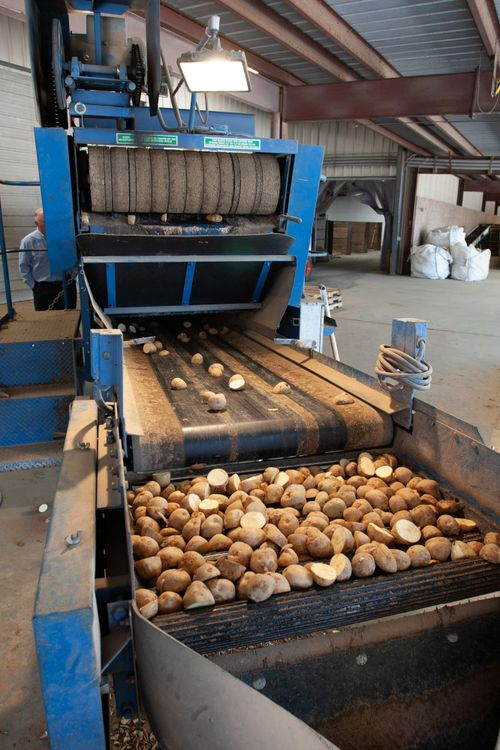
Grading and sorting have been a particular focus. The business uses Key Technology OCULUS optical sorting equipment to inspect washed whole potatoes, rotating individual tubers so cameras can examine more of the surface before defects are identified and product is separated into the appropriate stream.
Infrared cameras are used to identify green potatoes, while digital colour imaging supports detection of other visible defects. Cockerill says the systems have improved reliability and consistency compared with its earlier grading arrangements.
That consistency matters because fresh produce does not enter a factory with the uniformity of an engineered component. Potato size, colour, surface condition, moisture, and defects vary with crop, variety, field conditions, storage, and handling, while retailers expect finished packs to remain within relatively narrow specifications.
Automated inspection can apply those rules more consistently at production speed, but yield remains as important as rejection accuracy. Cockerill separates material into first-class packing product, secondary uses, and potatoes suitable only for animal feed rather than treating every rejected tuber as waste.
The distinction affects economics across large volumes. A sorting system that removes defects accurately while preserving usable secondary material can improve both customer quality and raw-material utilisation, whereas excessively aggressive rejection simply transfers value from saleable product into waste streams.
Robotic handling has also been introduced downstream. Equipment from LAN Technologies can alternate between merchandising units and trays, changing packing heads automatically according to the required format.
Cockerill uses shaker plates beneath merchandising units while flexible potato bags are loaded. Periodic vibration allows the packs to settle further into the available space, improving container utilisation without requiring operators to rearrange them manually.
The next investment phase will extend automation across packing and stacking. Cockerill says additional tray erectors and palletising systems are planned as the business looks to increase productivity and maintain a viable proposition for customers.
That progression illustrates a common pattern in food-factory automation. Once grading or primary packing becomes faster, bottlenecks often move to the next manual operation. A high-speed sorter cannot deliver its full benefit if completed packs accumulate while trays are erected, cases are stacked, or pallets are built by hand.
The company is therefore concentrating on the interfaces between established systems rather than presenting automation as a single project with a defined end point. Each new machine changes the balance of the line and exposes the next stage where labour, handling, or waiting time restricts throughput.
Cockerill is also training employees to oversee the automated equipment. More automation reduces some repetitive manual tasks but increases the need for operators capable of monitoring performance, carrying out changeovers, responding safely to faults, and recognising when inspection or robotic systems have drifted from the required specification.
Optical sorting in particular depends on those decisions. Cameras and algorithms provide consistency, but product specifications still have to be configured around crop condition and customer requirements. An automated system cannot decide independently whether a borderline defect is commercially acceptable for a particular retail pack.
The Dunnington operation forms part of a vertically integrated potato business spanning farming, storage, packing, transport, logistics, and potatoes supplied for further processing. Cockerill says it handled more than 225,000 tonnes during its most recently reported year and farms more than 1,000 hectares of arable crops.
That broader structure gives factory automation a relationship with field and storage decisions. Better grading can recover more value from incoming crop, but the condition of that crop is influenced months earlier by variety selection, weather, harvesting, storage temperature, and handling.
Cockerill has also linked the current investment programme with regenerative farming practices and waste reduction. Those initiatives are commercially useful when they improve crop quality or raw-material utilisation, although factory automation remains the point at which individual potatoes are finally assigned to a customer specification or secondary use.
The business has invested heavily before. Earlier work included a multimillion-pound grading line incorporating washing, destoning, polishing, drying, optical sorting, weighing, bagging, and robotic handling. The £1.65 million programme therefore extends a production architecture already built around automated inspection and packing.
Aldi’s increasing volumes provide the commercial justification. Long-term customer demand gives a manufacturer more confidence that new equipment will operate at sufficient utilisation to repay the capital, while higher throughput makes manual bottlenecks more visible and more expensive.
Cockerill’s latest investment is consequently less about replacing people with one dramatic piece of machinery than removing friction between processes. Sorting, bagging, tray handling, stacking, and palletising increasingly have to operate as one system, because an automated line only runs as quickly as the least automated part of it.