IN Brief:
- European alternative-protein companies raised €236 million in private investment during H1 2026, 56% above the equivalent 2025 period.
- Precision fermentation attracted €100 million and biomass fermentation €99 million, while plant-based meat and dairy investment fell sharply.
- Grants, loans, and equity are increasingly being combined as companies encounter the capital requirements of commercial-scale production.
GFI Europe says European alternative-protein companies raised €236 million in private investment during the first half of 2026, an increase of 56% compared with the same period last year. The improvement was heavily concentrated in fermentation, rather than representing a uniform recovery across plant-based, cultivated, and fermentation technologies.
Europe accounted for more than three quarters of private investment in the sector worldwide during the six months. Global funding nevertheless fell from €341 million in the first half of 2025 to €306 million this year, while the number of investment deals roughly halved, leaving a larger proportion of available capital concentrated among fewer recipients.
Precision-fermentation companies raised €100 million, already exceeding the €97 million invested across the whole of 2025. Biomass-fermentation companies attracted a further €99 million, compared with €61 million during all of last year. Among the larger transactions were €25 million for French precision-fermentation company Verley and €18 million for Dutch biomass-fermentation producer The Protein Brewery.
The divergence is particularly pronounced against plant-based food. European plant-based meat and dairy businesses attracted €18 million during the first half, down from €61 million in the comparable 2025 period. Cultivated-meat companies also raised €18 million, putting that segment close to the €20 million recorded across the whole of last year but still at a relatively modest absolute level.
Private investment is only part of the current financing picture. Fermentation companies also secured €67 million in grants during the first half, compared with €45 million of grant funding across all alternative-protein technologies in the equivalent period last year.
Factory economics are reshaping funding
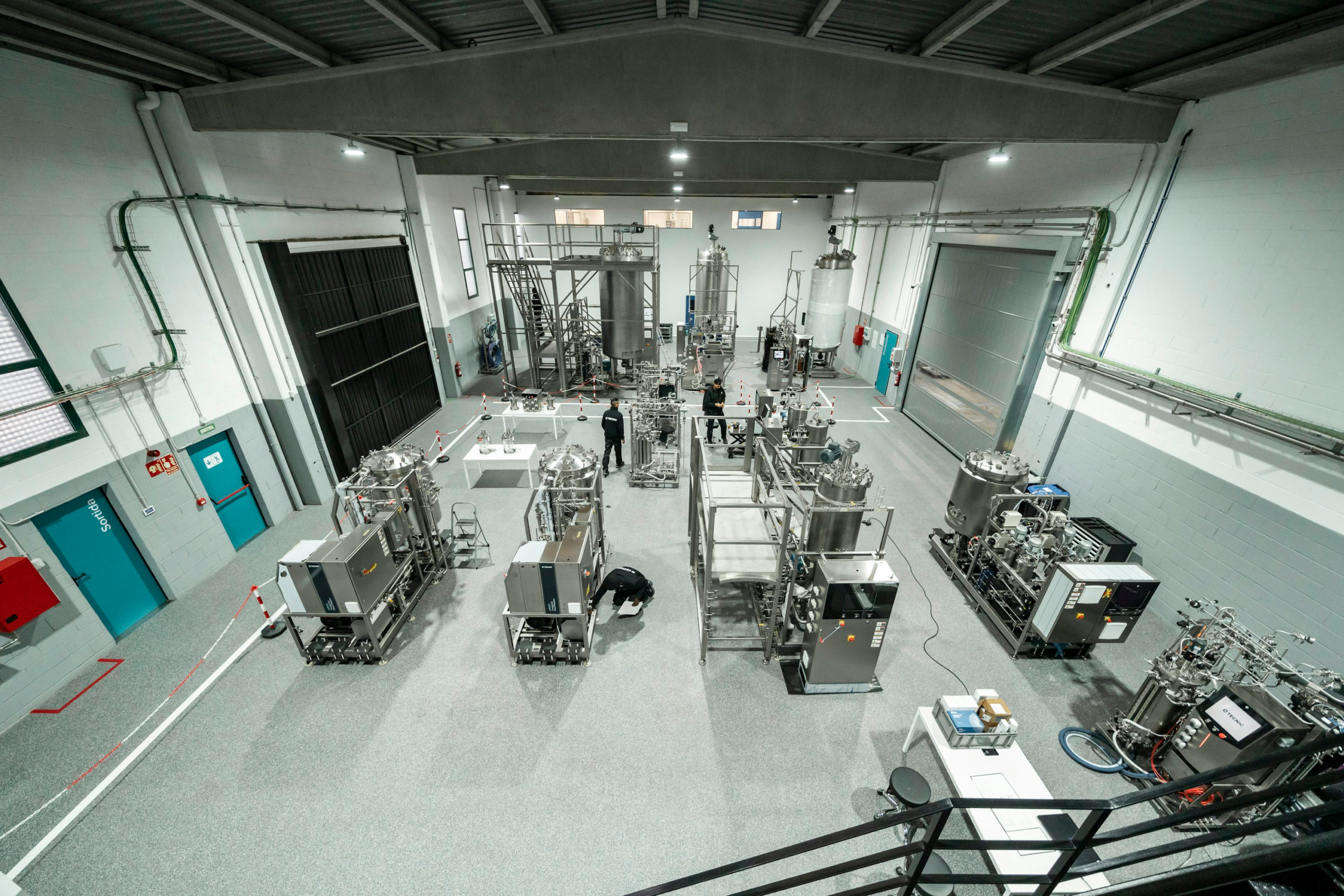
The growing use of public finance reflects the industrial stage now reached by parts of the sector. Producing proteins through fermentation at commercial scale requires fermentation vessels, downstream separation, purification, drying, process-control systems, utilities, laboratories, warehousing, and enough working capital to operate the plant while customers complete qualification work.
Those requirements are difficult to fund using conventional early-stage venture models alone. A laboratory business can add researchers and pilot equipment incrementally, whereas a manufacturing project can require a large capital commitment before meaningful revenue begins. The cost arrives early, while utilisation and market demand often take substantially longer to prove.
Several recent European packages show how financing structures are adapting. Solar Foods received a €78 million package from Business Finland comprising a €40 million grant and €38 million loan, while Vivici secured €12.5 million through the European Innovation Council Accelerator. A consortium led by UK company Adamo Foods received a €10 million EU grant for fermentation scale-up.
The trend is already visible in physical manufacturing projects. ADM is converting existing fermentation infrastructure for protein production, while MAASH has raised capital for mycoprotein scale-up. Both examples place equipment, capacity, and commercial manufacture ahead of the earlier industry’s emphasis on laboratory novelty.
Fermentation also presents a different investment proposition from much of the plant-based sector. Plant-based manufacturers can draw on established mixing, extrusion, forming, thermal-processing, and packaging equipment, even where formulations remain technically demanding. Fermentation companies may need bespoke biological and downstream processes whose performance at industrial scale is less extensively demonstrated.
That technological difference partly explains why the headline 56% rise should not be read as a general recovery in alternative proteins. Capital is concentrating where investors and public bodies see credible industrial milestones, while the fall in deal numbers indicates that weaker propositions are not necessarily benefiting from the larger European total.
Plant-based businesses face a different constraint. Many are beyond the stage where production technology itself represents the central uncertainty, leaving sales growth, product positioning, manufacturing costs, retailer support, and margin improvement to determine whether additional investment can be justified. Consolidation among smaller companies reflects that shift.
Cultivated meat remains caught between the two. Its relatively limited funding total arrives while companies continue to develop production systems, seek regulatory approvals, and plan demonstration capacity, all before conventional large-scale food economics can be established. Germany’s Innocent Meat, for example, raised €6 million for automated production technology, regulatory work, and development of a demonstration facility.
Europe’s first-half numbers consequently describe a narrowing market for capital rather than a return to the funding environment seen earlier in the decade. Fermentation has taken the largest share because businesses are entering expensive scale-up programmes, and grants and government-backed finance are increasingly filling parts of the gap left by more selective private investors.
The next measure will be physical output. Capital committed to fermentation plants will ultimately be judged against commissioned capacity, utilisation, manufacturing cost, customer qualification, and repeat orders — figures that are considerably less forgiving than fundraising totals.