IN Brief:
- Ferrero has agreed to acquire Boulder-based Purely Elizabeth for an undisclosed price.
- The business has more than doubled sales over two years across granola, oatmeal, cereals, and newer protein products.
- Purely Elizabeth will remain a standalone brand, with founder Elizabeth Stein continuing to lead the company.
Ferrero Group has agreed to acquire US breakfast-food company Purely Elizabeth, extending its expansion beyond confectionery into granola, oatmeal, cereals, protein products, and the wider better-for-you food market.
The transaction was announced on 14 August and is expected to close in the coming months, subject to customary closing conditions and regulatory approvals. Ferrero has not disclosed the purchase price.
Purely Elizabeth will continue operating as a standalone brand following completion, with founder and chief executive Elizabeth Stein remaining in her role alongside the company’s existing leadership team. Ferrero plans to support the business through product development, operational capabilities, and wider distribution rather than immediately absorbing the brand into another portfolio.
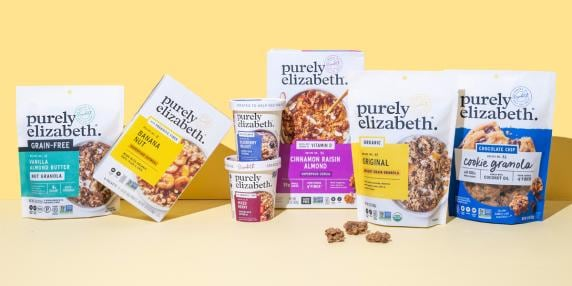
Founded in Boulder, Colorado, in 2009, Purely Elizabeth sells granola, oatmeal, cereals, and other breakfast products using ingredients including oats, whole grains, nuts, and seeds. Ferrero says the business has more than doubled sales over the past two years and has expanded more recently into protein-focused products.
The acquisition adds another breakfast platform to a Ferrero portfolio that has changed substantially in recent years. Its 2025 acquisition of WK Kellogg Co brought a large North American cereal operation into a group historically associated more closely with chocolate, confectionery, biscuits, and sweet packaged foods.
Purely Elizabeth is smaller, but its positioning is different. The brand sits in premium and wellness-focused breakfast categories, giving Ferrero exposure to consumers looking for products built around grains, seeds, functional nutrition, and higher-protein formulations rather than traditional mainstream cereal alone.
Manufacturing requirements across those products can be deceptively complex. Granola and cereal lines have to manage dry ingredients with different densities and particle sizes, oils and sweeteners, inclusions, nuts, seeds, allergens, baking or extrusion processes, cooling, breakage, and accurate filling into retail packaging.
Oatmeal creates another production pattern, while protein-focused products can introduce ingredients whose flavour, water absorption, particle behaviour, and nutritional contribution affect the final recipe. Greater protein content does not automatically make a product straightforward to manufacture, particularly where consumers expect the same texture and eating quality as the original range.
Growth also creates operational pressure before any acquisition takes place. A company that has more than doubled sales in two years needs ingredient supply, manufacturing capacity, packing output, quality assurance, finished-goods inventory, and distribution to expand at a similar rate if service levels are to be maintained.
Ferrero’s scale gives Purely Elizabeth access to substantially larger commercial resources. The group has more than 50,000 employees and operations in over 170 countries, with businesses spanning confectionery, biscuits, bakery, ice cream, cereals, snacks, and other packaged-food categories.
The buyer has not announced manufacturing transfers, plant closures, new production lines, or changes to Purely Elizabeth’s current production arrangements. The industrial case therefore rests initially on Ferrero’s ability to support growth rather than on a specific factory integration programme.
Keeping the acquired company standalone may make that transition easier. Product businesses positioned around rapid innovation can lose some of their development speed if every decision is immediately absorbed into a much larger corporate structure, while Ferrero can still provide support in areas such as procurement, quality systems, distribution, manufacturing expertise, and commercial planning.
The transaction also fits a wider pattern in Ferrero’s acquisition strategy. Alongside WK Kellogg, the group has expanded through businesses including Eat Natural and FULFIL in Europe, Power Crunch in North America, and Bold Snacks in Brazil, widening its presence in breakfast, protein, snacks, and better-for-you categories.
That expansion gives the group a broader range of manufacturing models than its traditional confectionery base. Grain processing, cereal production, baked products, bars, protein snacks, and granola all depend on different ingredients and line technologies, but they also create opportunities for purchasing scale, packaging procurement, distribution, and product-development expertise to be shared across businesses.
Purely Elizabeth’s growth will determine how quickly those capabilities become necessary. Expanding distribution can increase demand faster than existing manufacturing arrangements were designed to handle, forcing decisions around additional production shifts, co-manufacturing, line investment, warehousing, or the use of capacity elsewhere in a larger group.
Ferrero has not said which of those routes it intends to take. Its announcement instead emphasises continuity, growth, and preservation of Purely Elizabeth’s identity, making major factory changes speculative at this stage.
That leaves a relatively straightforward acquisition thesis: Ferrero is buying a rapidly growing breakfast business with established products and customer demand, while Purely Elizabeth gains the resources of a global food manufacturer without immediately surrendering its standalone operating identity.
The difficult part comes after closing. Growth brands need scale, but scale introduces procurement discipline, factory constraints, quality systems, and distribution complexity. Ferrero’s task will be to provide those capabilities without removing the speed and product focus that made Purely Elizabeth attractive enough to buy in the first place.