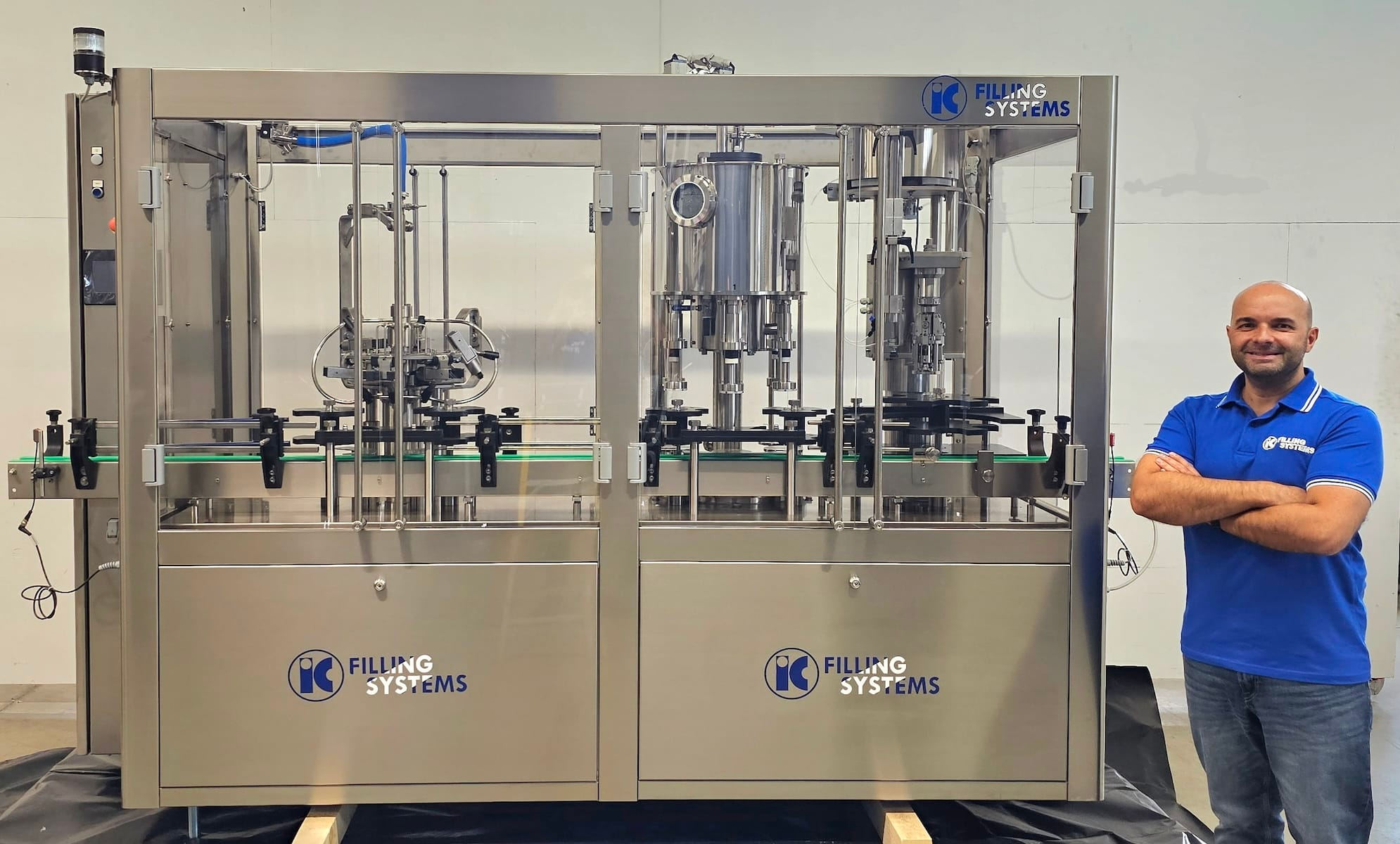
IN Brief:
- IC Filling Systems reports a successful factory acceptance test for a bottling monoblock intended for a customer facility in England.
- Two single-head capping turrets accommodate 26mm crown corks, ROPP aluminium caps, T-corks and mushroom corks, with external wire hooding for the latter.
- The supplier quotes tool-free format changes taking 10–15 minutes; site installation, commissioning and sustained production performance remain unreported.
IC Filling Systems has completed a customer-approved factory acceptance test for a bottling monoblock destined for a site in England. The equipment combines filling with capping technology capable of handling four different closures and is specified for still and carbonated beverages. The factory test marks a pre-delivery approval; installation at the customer’s facility is planned for the coming weeks.
The supplier calls the equipment a 12/16/1/1-ISO model. Two single-head capping turrets handle 26mm crown corks, roll-on pilfer-proof (ROPP) aluminium screw caps, T-corks and mushroom corks. A wire-hooding unit positioned outside the monoblock completes the mushroom-cork process. The four-format arrangement is intended to reduce the amount of separate capping equipment needed when a producer runs different bottled beverages.
Each revolving turret is configured for two closure types, allowing the machine to accommodate a wider range of finishes within the same integrated installation. Bottle neck geometry, closure dimensions and the torque or insertion force required by a particular cap still determine the compatible settings. The supplier has not provided the tooling specification for each format, so the approved design should not be read as a claim that every closure uses an identical mechanical head.
IC Filling Systems quotes tool-free format changes of 10–15 minutes for the configured machine. Its announcement also lists cylindrical, oval, rectangular and custom bottle shapes among the accepted formats. Changing a run may involve adjustment of bottle transport, filling parameters, closure supply and guide components as well as the capping station. The stated changeover interval is a supplier figure for the machine rather than an independently documented average across the customer’s production schedule.
A line specified for both still and carbonated drinks must accommodate different product behaviours during filling. Carbonated beverages can foam or lose dissolved gas when pressure and temperature are not controlled appropriately, whereas still products may follow a different operating sequence. The installed process must also deliver the required fill volume and protect product integrity. IC Filling Systems has confirmed the intended beverage types without publishing the customer’s detailed valve arrangement or filling protocol.
Closure selection also depends on the bottle finish and intended product. Crown corks are associated with specific glass neck finishes, while roll-on pilfer-proof caps form threads around compatible bottle finishes. T-corks are commonly used where a removable stopper is desired, and mushroom corks may require additional restraint from wire hooding. A machine able to handle these closures provides flexibility, but compatibility cannot be inferred solely from the fact that a bottle is cylindrical or made of glass.
Factory acceptance testing checks agreed equipment functions before shipment, normally at the supplier’s works under a project-specific protocol. Customer approval establishes that the demonstrated machine met the acceptance conditions for that stage. Site acceptance is separate: the unit must then work with the receiving plant’s utilities, container supply, product, operating procedures and downstream equipment. The published account does not include numerical factory-test results or the purchaser’s detailed test criteria.
The equipment will be integrated into a broader bottling process once delivered. Bottle feeding, closure orientation, filling, cap application, any required wire hooding and transfer to inspection or labelling must remain synchronised. Changes in bottle shape can affect guide settings and handling stability, while different closure supplies may require their own feeding arrangements. A misfeed at any of these points can interrupt the line regardless of the number of cap formats accommodated by the monoblock.
Combining formats on one machine can reduce the need to keep several specialist capping stations available, particularly where a bottler produces short runs or seasonal ranges. The shared equipment also concentrates changeovers and maintenance in one part of the line, so the benefit depends on the frequency of switches and the reliability of the feed and capping sequence. The supplier has not released a customer-specific comparison of floor space, utilisation or labour demand.
The English customer has accepted the machine after factory testing, and IC Filling Systems expects to install it within weeks of its 2 November announcement. Its next commissioning work will involve the specific bottle shapes and closures selected for the project, including the separate mushroom-cork wire-hooding operation. The customer’s identity, contract value and rated throughput were not disclosed in the published project account.
Site trials will establish how the two-turret configuration performs with the customer’s beverages, bottle shapes and closure changes. Repeatability across those formats, rather than factory acceptance alone, will determine whether the advertised 10–15-minute changeovers can be achieved in day-to-day production.