IN Brief:
- Novolex has opened a 17,500 sq ft Applied Innovation Center in Roanoke, Texas.
- Five simulated environments cover foodservice, grocery, retail, café and bakery, and quick service restaurant applications.
- A dedicated prototype room provides onsite forming, sealing and printing before packaging moves into commercial trials.
Novolex has opened a 17,500 sq ft Applied Innovation Center in Roanoke, Texas, combining packaging prototyping equipment with simulated foodservice, retail and grocery environments. The facility is designed to move development closer to the conditions a pack will face before manufacturers commit valuable production line time to a commercial trial.
Five settings cover foodservice, grocery, retail, café and bakery, and quick service restaurant applications, while a separate prototype room provides onsite forming, sealing and printing. Bringing those capabilities together allows a material or pack concept to be assessed as a working system rather than as an isolated substrate sample.
That distinction matters because flat material data cannot establish whether a finished package will run successfully. A substrate may meet strength or barrier specifications in the laboratory and still fail after it is formed into a tray, folded into a container or passed through sealing equipment. Bends, corners and drawn sections redistribute stress, while dimensional variation can affect denesting, filling and closing on automated lines.
Sealing introduces another layer of process sensitivity because heat, pressure and dwell time have to create a consistent bond without damaging the material or slowing the machine excessively. A structure with a narrow sealing window may perform well under controlled development conditions yet become difficult to run when product temperature, ambient conditions or material lots vary during routine production.
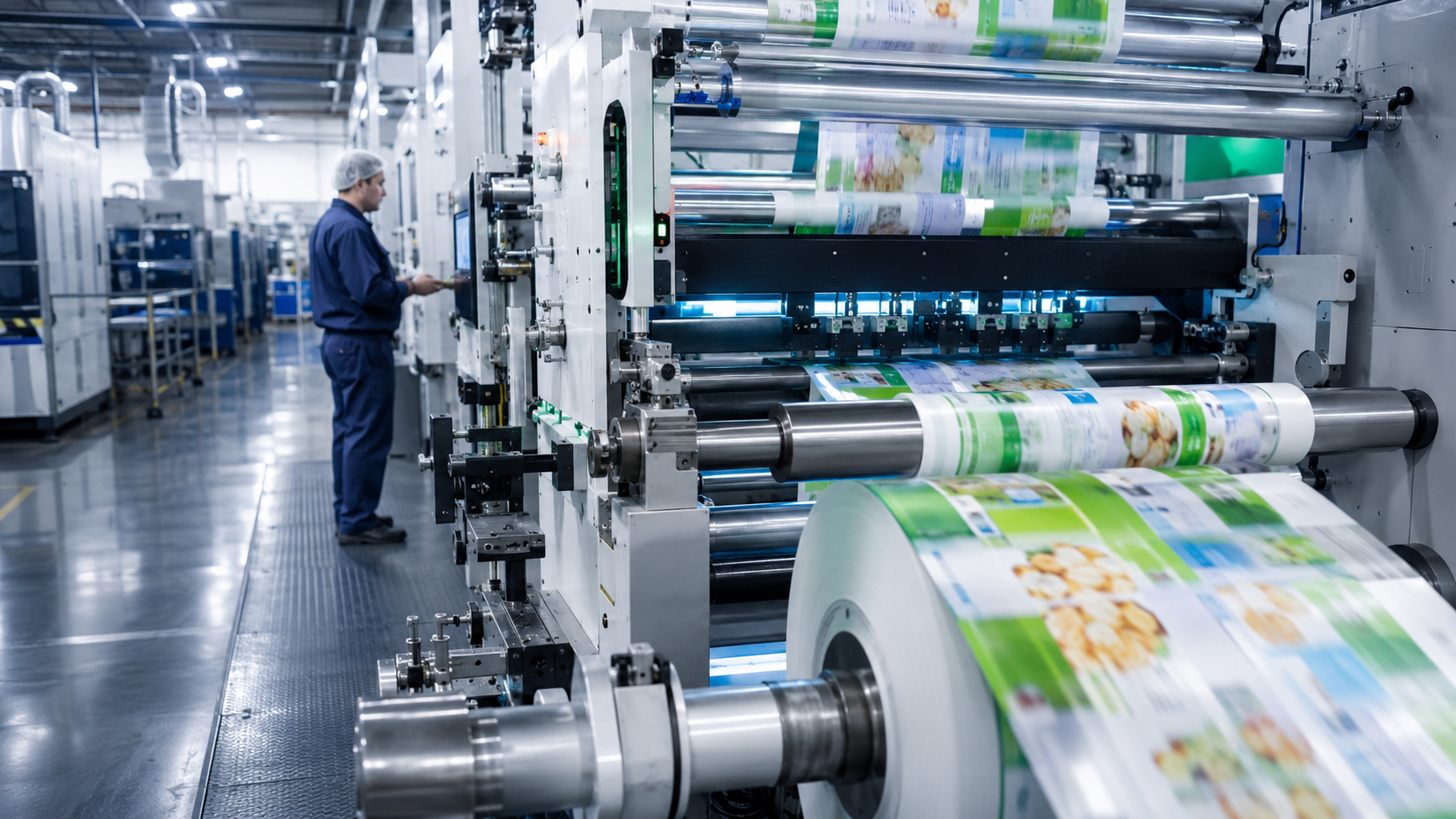
Printing can alter the same system because inks, coatings and surface treatments need to adhere through distribution and consumer handling while remaining compatible with sealing areas. Depending on the construction, they can also affect food contact or recycling considerations, so visual design and production performance cannot be treated as entirely separate workstreams.
By putting forming, sealing and printing inside one prototype environment, Novolex can test those interactions before a customer reaches the factory floor. This can reduce disruption inside food plants where line time produces saleable output and repeated trials with immature packaging designs are expensive. Development work does not remove the need for a commercial test, but it can eliminate weaker concepts before they consume a full production slot.
The simulated market environments extend that testing beyond the converting process. Hot takeaway food, chilled grocery products, bakery goods and retail merchandise expose packaging to different temperatures, moisture loads, handling patterns and storage periods, meaning a container suitable for one application may perform poorly in another despite using the same base material.
Food packaging also has to protect the product for its intended life, which complicates efforts to reduce material or increase recyclability. A lighter or simpler structure can create a larger environmental penalty if it increases leakage, physical damage or spoilage, so development has to balance material reduction against the protective function the pack is expected to perform.
Novolex’s portfolio spans more than 250 brands and around 39,000 stock keeping units across fibre, plastic and specialist structures. That breadth gives customers several possible routes to solve the same packaging problem, but it also increases the need for comparative testing because cost, stiffness, grease resistance, sealing behaviour, pack weight and recovery after use do not always improve in the same direction when a substrate changes.
A bakery pack, for example, may need enough moisture movement to preserve texture while still protecting the product from physical damage. Increasing barrier performance is not automatically beneficial if trapped moisture softens a crust or creates condensation, just as a quick service container has to withstand hot food, grease, sauces, stacking and rapid handling without losing stiffness or leaking.
Those examples explain why the Roanoke centre cannot replace commercial validation. Customers still need trials on their own fillers, sealers, case packers and distribution systems because machine speed, product temperature and site specific handling can expose problems that a development environment cannot reproduce completely. The centre’s role is to move that factory trial later, after the basic forming, sealing, printing and handling risks have already been reduced.
Successful prototypes must then be reproduced consistently by Novolex manufacturing operations. A pack made correctly once has little commercial value unless geometry, material properties and sealing characteristics remain stable over long production runs, which means quality control and process capability become the next step after prototype approval.
The Roanoke facility therefore sits between material development and full production, with its value determined by how effectively it shortens the route between the two. If forming, sealing, printing and realistic handling can identify failure modes earlier, customers can enter commercial trials with fewer unknowns and less disruption to manufacturing lines that are expected to keep producing saleable food.