IN Brief:
- Schur demonstrated a SchurBagger arrangement receiving counted portions through two collection funnels and belt transfers.
- The presented sequence indexes two premade resealable bags at a time, but the booth demonstration used hypothetical fruit portions.
- No verified fruit-damage figures, operating speed, industrial installation or customer trial results were disclosed.
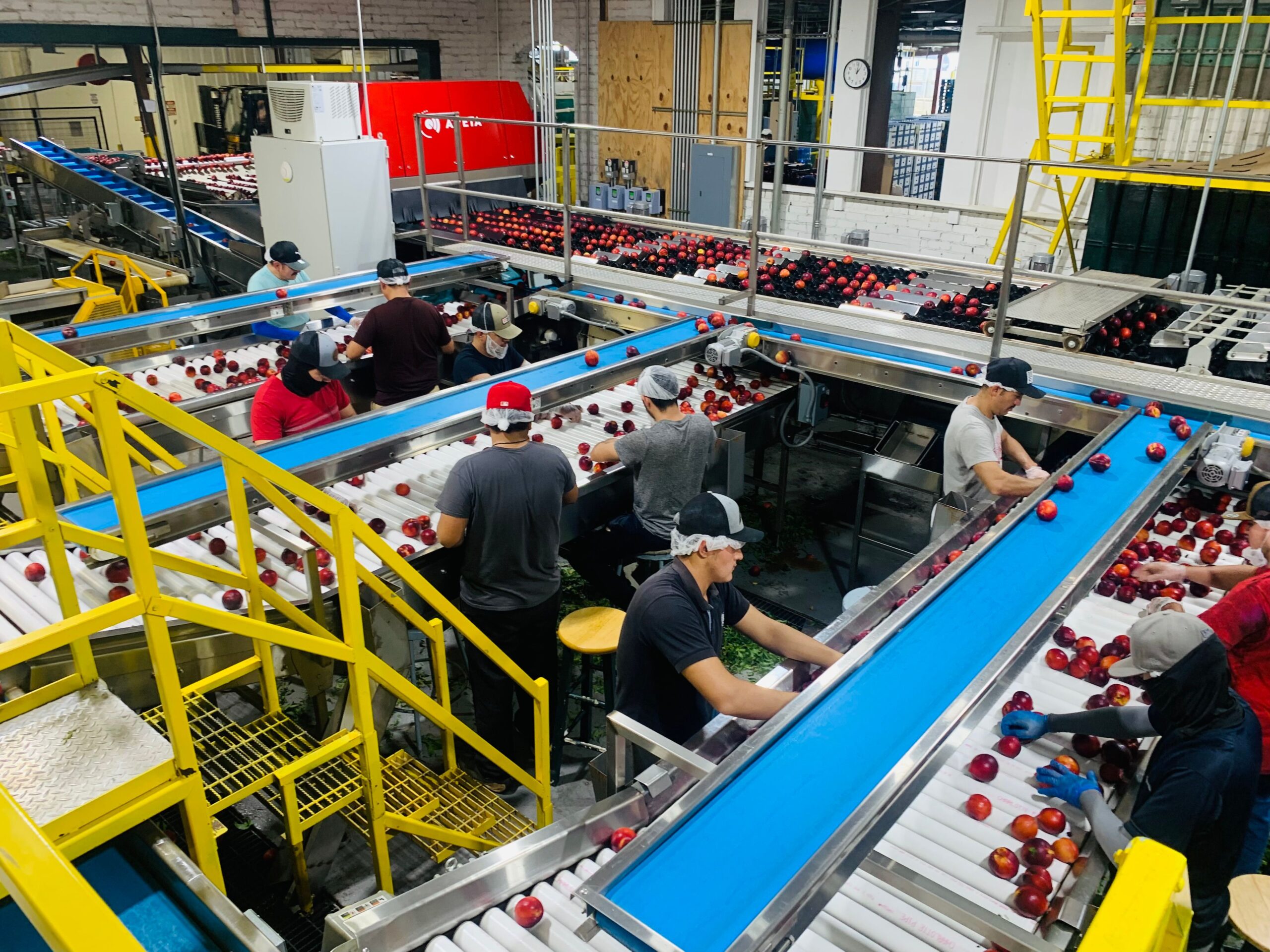
Schur Star Systems has demonstrated a SchurBagger configuration intended to fill premade resealable bags with counted portions of stone fruit. At PACK EXPO on 18 October, representative Bent Rahbek described how an upstream counting unit feeds two collection funnels before the machine transfers portions towards a pair of bags. The presentation explained the arrangement for delicate produce, including peaches, but did not report results from a production installation.
In Schur’s established Star system, interconnected premade bags are drawn from a box and indexed through the filling machine. The exhibited development adds a counting-unit interface ahead of two funnels and two belt-transfer paths. Each funnel holds a portion until its bag is presented; the belts then carry that portion to the waiting bag before the next pair is indexed. Rahbek ran through the motion using hypothetical portions rather than actual fruit, making this a demonstration of sequencing and machine arrangement rather than a measured handling trial.
Counting individual pieces is a different packaging task from depositing a preset weight. A peach’s mass varies with its size and maturity, so an accurately counted bag can still differ in weight from the next. Where a declared net weight must also be met, weighing or an equivalent check remains necessary. The upstream counter can establish the required piece quantity before each release, but the presentation offered no measured counting accuracy across different fruit grades or rates of arrival.
The twin funnels form a buffer between the incoming fruit stream and the intermittently moving bags. That arrangement allows portions to be prepared while the previous pair is cleared, provided the upstream feed and bag indexing remain synchronised. Incorrect timing could direct pieces towards a closed or missing bag mouth, so a commercial installation would require controls for bag presence, release permission, stops and recovery. The exhibition account did not provide the machine’s interlock design, feed limits or sustained cycling speed.
Stone fruit also poses a mechanical challenge because impact and compression can produce bruising even when the surface appears unbroken. The severity depends on fruit condition, contact geometry and movement through drops, chutes and belt transitions. Schur’s intended gentler transfer route may reduce abrupt handling, but that benefit has not been quantified through comparative damage tests. Verified performance would require trials using representative varieties, maturity levels and bag formats, not an inference from the presence of belts.
Premade zipper bags allow the reclosure component to be manufactured into the pack before it reaches the filling position. A separate initial closure still has to be appropriate for the product and distribution conditions. The demonstration did not identify a certified seal strength, breathable-film specification or modified-atmosphere arrangement, and none should be assumed. Bag opening geometry and alignment must also accommodate the fruit without scraping or trapping it in the mouth of the package.
Fruit packing also requires that counting and conveying equipment cope with variations in the incoming crop. Pieces can overlap, roll at different speeds or arrive with stems and surface moisture that affect sensing and transfer. If a counter undercounts or two pieces travel together, the final pack may deviate from its intended quantity. Pack-line validation would therefore need to measure counting accuracy across size grades and feed conditions, as well as test the behaviour of the transfer system during routine stops and restarts.
Belt runs, funnel interiors and product-contact surfaces also require access for cleaning, with maintenance procedures suitable for the fresh-produce environment. Residues or damaged fruit can remain at transfer points if components are difficult to reach, while cleaning agents and water exposure must be compatible with the fitted machine parts. The presentation did not give a hygienic design certification, washdown rating or cleaning validation results for this configuration, so those aspects remain for site-specific assessment.
The concept may be adapted to a range of delicate whole-fruit products, but applications beyond the displayed stone-fruit example remain subject to trials. Changing fruit dimensions or bag format alters the relationship between counting, funnel volume, transfer clearances and the position of the pack opening. Those engineering adjustments determine whether the two-bag process can preserve counting consistency and prevent product scuffing or misfeeds. The exhibition material does not establish a universal size range or guaranteed output for every fruit.
The 18 October demonstration establishes how Schur intends to connect counted portions with a two-bag filling cycle, while leaving industrial performance unmeasured. Its next useful benchmarks would be sustained output, counting errors, bruising, missed transfers and changeover time under representative packing-house conditions. No customer installation or comparative shelf-life result accompanied the presentation, and the mechanical sequence shown at the stand should not be mistaken for validated production throughput.