IN Brief:
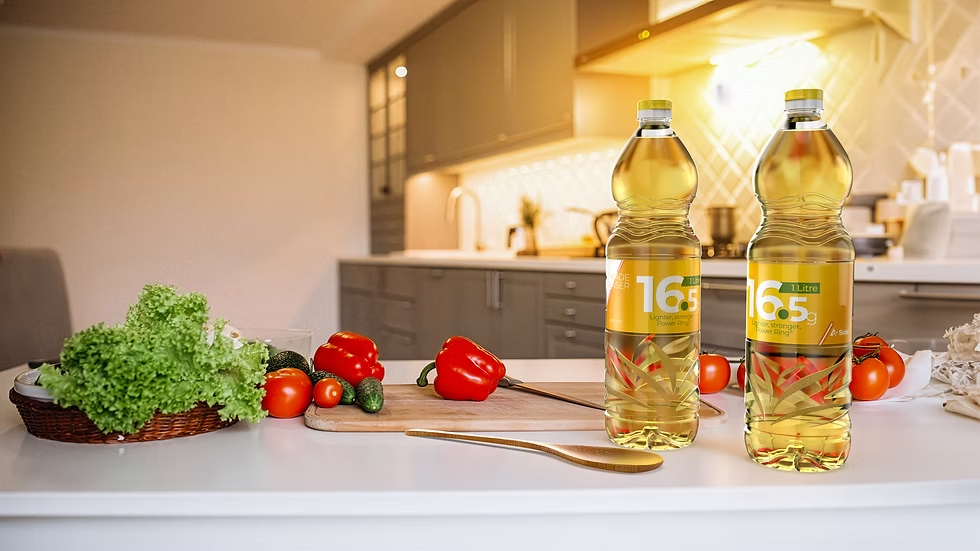
- The 1L edible oil bottle weighs 16.5g, reducing material use by 20% compared with a conventional 20.5g halogen-blown format.
- Laser heating and a Power Ring base structure concentrate PET in areas exposed to higher mechanical stress.
- The design is compatible with 100% rPET, supporting lightweighting, circularity, and logistics efficiency.
Sidel has introduced a 1L edible oil bottle produced using laser heating technology, reducing the pack weight by 20% while preserving the mechanical performance required through filling, storage, distribution, and use.
The bottle weighs 16.5g, compared with 20.5g for a comparable halogen-blown version. Its structure redistributes PET into areas exposed to greater mechanical stress, removing unnecessary material from lower-load sections while reinforcing zones that influence bottle strength and handling.
The design uses Sidel’s Power Ring structure around the bottle base and body. The feature is designed to support vertical strength and top-load resistance, while helping the bottle retain grip and stability during opening and pouring. Edible oil formats face distinct handling demands because the product is dense, frequently packed in larger sizes, and often leaves residue on bottle surfaces during use.
The bottle is compatible with 100% recycled PET. That gives the format a combined material-reduction and recycled-content proposition, lowering the amount of plastic used per bottle while allowing a shift away from virgin resin. In high-volume edible oil lines, gram-weight reduction can translate into lower resin demand, lighter pallet loads, and reduced transport weight across distribution networks.
Sidel is presenting the laser-blown bottle alongside its halogen-blown equivalent at Interpack 2026, giving direct comparison of pack weight, strength, and material distribution. The demonstration places the focus on the blow-moulding process as much as on container design, showing how heating technology can influence preform stretch behaviour and final bottle performance.
PET packaging is being squeezed by recycled-content targets, cost control, retailer sustainability demands, and the need to maintain filling-line efficiency. Edible oil adds further complexity because packaging must cope with load-bearing requirements, shelf stability, consumer grip, and the risk of deformation during handling. Lightweighting programmes that cut too aggressively can create problems downstream in warehouses, on pallets, or during consumer use.
Laser heating gives packaging producers a route to more precise preform conditioning. By directing energy more accurately before blowing, material can be placed where it delivers structural value, instead of being distributed more broadly across the container. That approach could support further downgauging in categories where pack strength has historically limited weight reduction.
The development also shows how packaging sustainability is moving beyond simple substrate substitution. Recycled content alone does not reduce total material use, while lightweighting alone can undermine pack performance if it is detached from process control. Sidel’s bottle combines resin reduction, rPET compatibility, and structural optimisation within a single production route.
For edible oil manufacturers, the main test will be repeatable line performance at scale. If the format holds its strength through filling, palletisation, transport, and retail handling, it gives the category a practical route to reduce plastic intensity without moving away from PET.