IN Brief:
- TRAZO is developing robotic palletising that learns load patterns from physical examples built by production operators.
- A 2D vision system will digitise demonstrated patterns before software generates the three-dimensional arrangement and robot movements.
- Two food-sector pilots will test whether the approach can handle industrial operating conditions and changing production requirements.
Vitartis and three industrial partners are developing a palletising system that learns load patterns from physical examples created by food factory operators, reducing the programming required when case formats or dispatch requirements change.
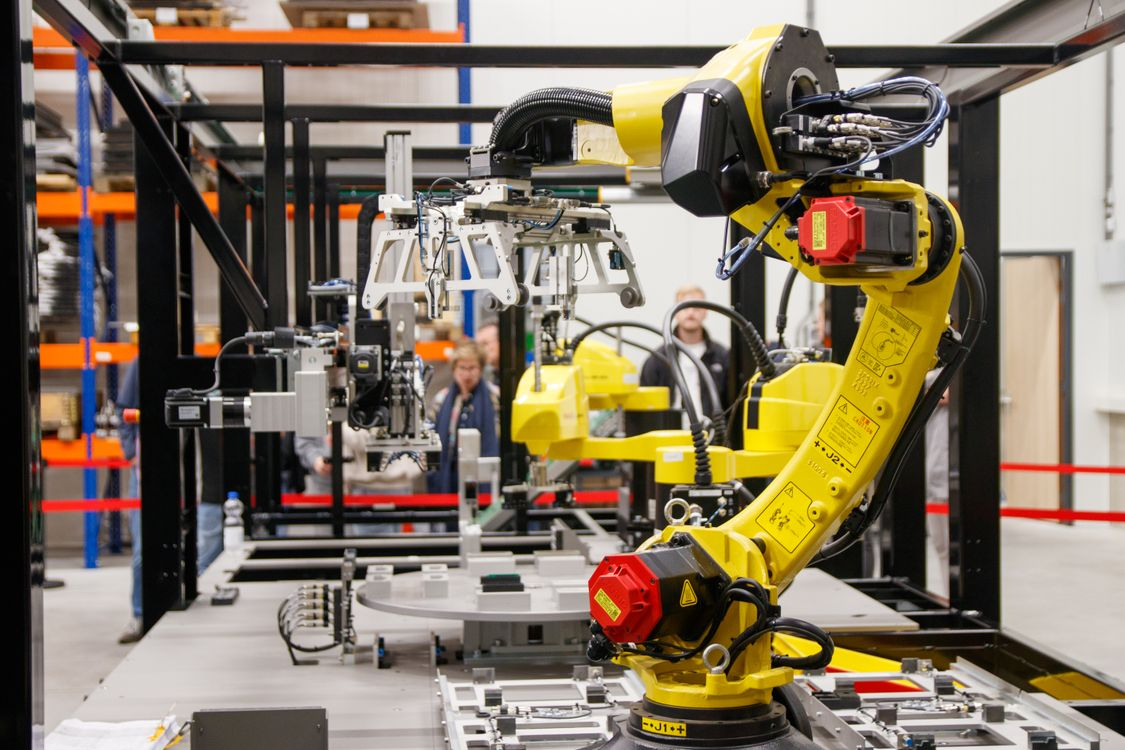
The TRAZO project combines artificial intelligence, 2D machine vision, and collaborative robotics. An operator will build or demonstrate the required pallet pattern physically, after which the system will capture the arrangement, convert it into machine-readable data, and calculate the movements needed for a robot to reproduce it.
Development is divided across project coordination, functional requirements, the intelligent palletising system, industrial integration and validation, and dissemination. The technical work includes a vision system to digitise patterns, a simplified operator interface, algorithms that generate the three-dimensional box arrangement, and automatic calculation of the robot trajectories needed to construct the load.
The system is due to be validated at two food businesses under industrial conditions. Vitartis is working with Industrias Maxi, Yllera Bodegas y Viñedos, and Grupo Oblanca, combining automation expertise with operating food and beverage sites where the system can be tested against real production variation.
TRAZO has a total budget of €201,669.21, with €86,519.95 provided through a Castilla y León programme supporting research and innovation within business clusters. The scheme is co-funded by the European Regional Development Fund.
Palletising appears simple compared with mixing, filling, or primary packaging, but a high mix production environment can make the final operation difficult to automate efficiently. Different case dimensions, weights, stacking rules, pallet sizes, dispatch requirements, and production sequences can all require new load recipes, while unstable products or mixed patterns introduce additional handling constraints.
Conventional robotic palletising manages that complexity through programmed recipes. Once a format has been defined, the robot can repeat it reliably, but a change normally requires someone to specify layer geometry, case orientation, pick and place positions, gripper behaviour, collision limits, and placement sequence.
TRAZO is intended to move part of that configuration work away from specialist robot programming. Operators already understand the product, the pallet requirement, and many of the practical rules applied at dispatch. Teaching from a physical example gives the system a way to translate that production knowledge into the mathematical representation needed by the robot.
Pattern recognition is only one part of the problem. A controller must also decide whether the demonstrated arrangement can be built safely and repeatedly using the available robot and gripper. Reach, payload, acceleration, case strength, intermediate stack stability, pallet position, and collision avoidance all constrain how a theoretical final arrangement can actually be assembled.
The project therefore treats trajectory generation as a separate technical task. Software has to convert a target three-dimensional stack into a feasible series of movements and then repeat those movements without collisions or unstable intermediate layers. If an operator still needs an automation engineer to rebuild every new recipe after the pattern has been captured, the main benefit of teaching by demonstration disappears.
Recent food automation projects have increasingly placed more intelligence in the vision and configuration layer. JLS Automation’s vision system, for example, combines 2D and 3D data to classify pickable products in irregular flows. TRAZO addresses a related flexibility problem at the opposite end of the line, using the operator’s demonstrated pallet as the starting point.
The industrial pilots will have to deal with conditions that do not appear in a clean laboratory demonstration. Damaged cases, dimensional tolerances, conveyor drift, partial pallets, unplanned stops, label variation, and operator intervention can all disturb the ideal sequence. The system also needs a clear response when a demonstrated pattern exceeds the robot’s reach, payload, or stability limits.
Collaborative robotics does not remove those engineering constraints. Cobots can simplify some forms of deployment and interaction, but palletising performance is still governed by payload, reach, cycle time, safeguarding, and the physical properties of the load. The useful measure is whether the complete system can move between formats with less engineering effort while maintaining the consistency required at dispatch.
That would be valuable at plants where product variety has made fixed palletising automation difficult to justify. End-of-line handling remains repetitive and physically demanding, yet the return on automation weakens quickly if every packaging change requires a lengthy programming intervention.
TRAZO is therefore testing a practical proposition rather than an abstract use of AI: whether the person who knows how the pallet should look can teach the robot directly. The two industrial pilots will determine how much of the programming burden can actually be removed once that idea is exposed to normal production variation.