IN Brief:
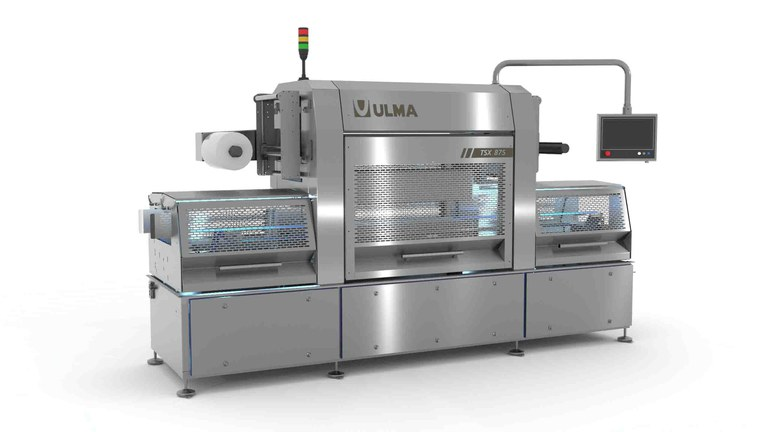
- The TSX 875 is the first traysealer in ULMA Packaging’s next-generation TSX range and targets Fast Skin applications.
- ULMA quotes up to 13 skin packaging cycles per minute, a machine-cycle claim rather than a measured pack-per-minute output.
- The platform supports variable product heights, recipe-based process settings and compatible recyclable films or flat cardboard bases.
ULMA Packaging UK has introduced the TSX 875 traysealer as the first machine in its new TSX platform, targeting vacuum skin packs for fresh and prepared foods. The company quotes up to 13 cycles a minute in Fast Skin operation, supported by changes to feeding, vacuum and sealing systems. That figure is a machine-cycle specification, not a guaranteed number of packs per minute or an independently measured whole-line output.
The machine builds on a packaging process in which a heated film is drawn down to follow the shape of a food product and sealed to a compatible base. Unlike a conventional lidded tray with a largely flat film cover, a skin pack uses film conformity to hold the product against the support and minimise the free space around it. The resulting package can improve presentation and reduce movement within the pack, provided that the selected film, tray or board, food geometry and process conditions are compatible.
The new platform coordinates feeding, film heating, vacuum application and sealing to help the film conform to different product profiles. The material must stretch over higher points without excessive thinning or tearing, while the sealing interface remains sufficiently clean and consistent to form a reliable bond. ULMA describes optimised vacuum and sealing systems alongside temperature control and selectable process recipes. The company has not released the full process window or independent defect-rate measurements for the range of applications listed.
Thirteen cycles per minute is the maximum performance figure ULMA gives for skin operation. Each cycle could form more than one finished pack where the tooling has multiple cavities, but the company has not specified a standard cavity count or a corresponding packs-per-minute figure. Actual line output also depends on product loading, film supply, rejects, format changes, and downstream handling. The published cycle rate should therefore not be treated as an hourly production guarantee for every food format.
Product height and tray configuration influence how the heated film is formed and sealed. A relatively tall or irregular item places different demands on film extension and material distribution from a flat product, and poor placement can affect the seal area. ULMA says the TSX 875 adapts to different product heights and formats, with recipe-based settings intended to support changeovers. Exact dimensional limits, tooling options and validated cycle rates for individual products were not provided in the launch information.
Film stress and sealing quality remain linked: excessive forming strain can cause pinholes or thinning, while an incomplete seal may reduce pack integrity during distribution. Controlled temperature and vacuum can support repeatable operation where settings are validated for the chosen film, product and support. ULMA has not supplied independently verified film savings, defect reductions or overall equipment effectiveness figures for the TSX 875. Its published benefits are therefore design and performance claims rather than the measured results of a named factory installation.
ULMA also lists compatibility with recyclable films and flat cardboard bases, including its LEAFSKIN format. A board support may incorporate coatings or sealant layers, so the finished pack’s suitability for recycling depends on the combined material structure and the recovery processes available where it is discarded. Machine compatibility does not determine whether a packaging format meets a particular local collection specification. Film and base selection must be checked together for sealing performance, protective function and the intended disposal route.
The package still needs to retain its protective function as well as provide the presentation associated with skin packaging. Validation would address film barrier properties, seal strength, package integrity and food storage conditions for each format. Vacuum skin systems can limit movement within the package, but any shelf-life extension depends on the product, hygiene, temperature and material specification. ULMA has not published a comparative shelf-life study for food packed on the TSX 875, so a quantified extension would be unsupported.
Upstream and downstream line equipment must work with the new traysealer’s rhythm. Product infeed affects positioning under the film, while coding, labelling, weighing and case packing must accommodate the final pack geometry. A traysealer running at its rated speed may still wait for a slower preceding or following process, particularly where multiple products and support formats share a line. ULMA has not supplied a complete integrated line trial showing net packs per hour under production conditions.
The TSX 875 is being offered as the first model in ULMA’s new traysealer platform, but the manufacturer has not disclosed a UK installed base, machine price, energy demand or confirmed orders. Its published specifications combine a higher stated maximum cycle rate with recipe control and alternative substrate options. Production results will depend on configured tooling, the product and package geometry, and completed performance trials for individual applications. The original product information was published on 4 November.