IN Brief:
- Dinnissen assembles, tests, adjusts, and validates complete production lines before shipment to the customer.
- Mechanical, electrical, process, and software functions are checked together at the company's D-Innocenter in Sevenum.
- Food-sector projects have already used customer products during pre-delivery testing to refine process settings and controls.
Dinnissen has formalised a production-line delivery model that moves a larger share of integration, testing, adjustment, and validation into its D-Innocenter before equipment reaches the customer’s factory.
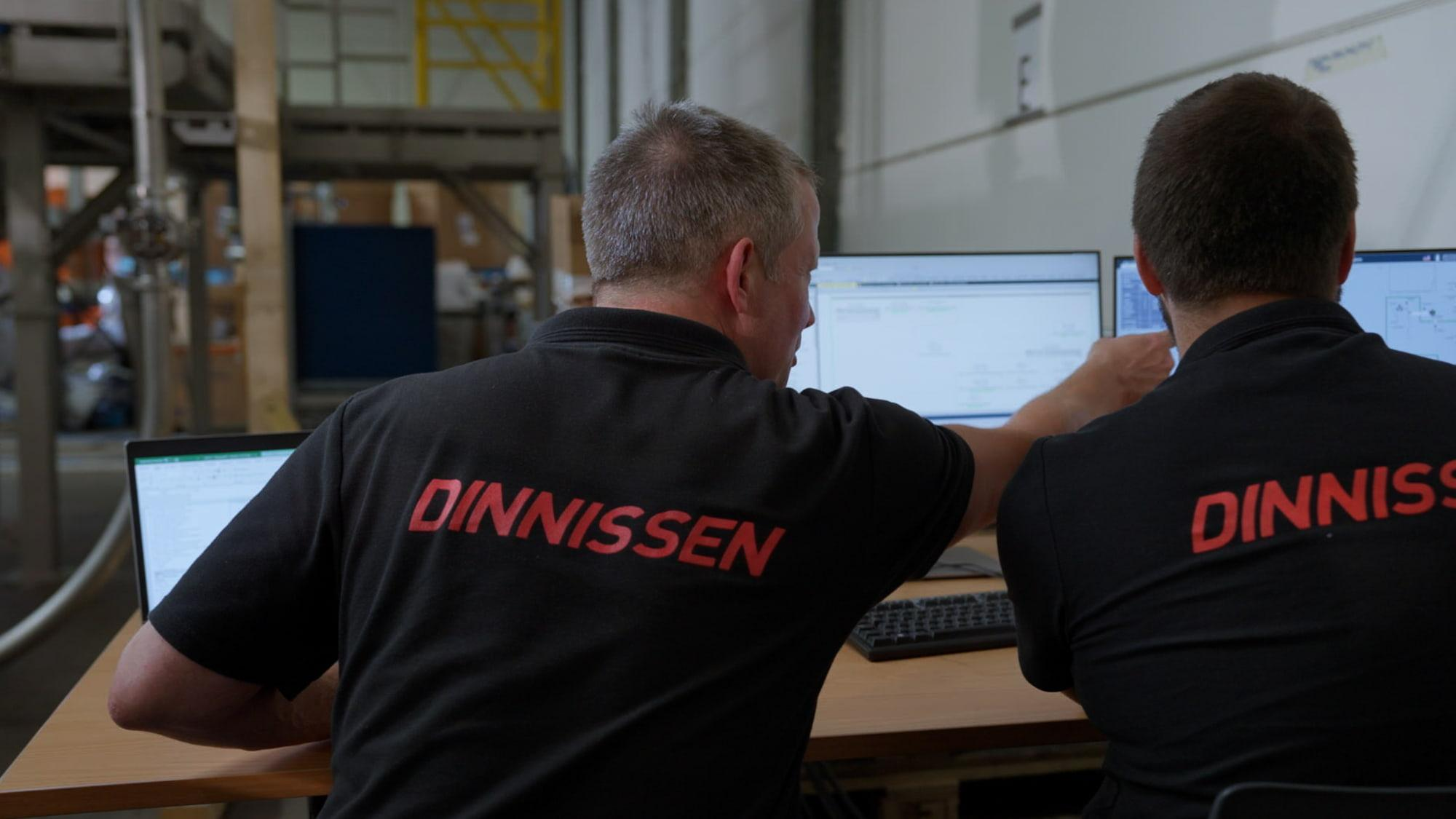
Under the Vertical Start-up approach, Dinnissen assembles the complete production line in Sevenum, the Netherlands, in a configuration intended to replicate the final installation. Mechanical, electrical, software, and process functions are then tested together rather than waiting until commissioning on site to identify system-level problems.
Any deviations found during the test period can be corrected while the equipment remains at Dinnissen. Settings are adjusted, software logic refined, and the line checked against agreed performance and functionality requirements before approval for shipment.
The validated system is then dismantled into structured skids for transport. On arrival at the customer’s plant, the work shifts towards positioning, assembly, connection, final testing, and site commissioning rather than making the factory the first place where the complete installation operates as one process.
The approach changes when project risk is concentrated. Traditional line installation can leave a substantial amount of integration work until production has already been interrupted, contractors are on site, and the manufacturer is waiting to restart or begin commercial output.
A mechanical or controls problem found at that stage carries an operational cost as well as an engineering one. Production windows can be lost, additional labour may be required, and product used for trials can be scrapped while process settings are stabilised.
Individual machines can pass their factory acceptance tests and still create problems once connected. Conveying rates, feed consistency, buffer capacity, transfer heights, interlocks, control handshakes, alarms, recipes, and sequence logic only become fully visible when the system runs as a complete line.
Testing the integrated installation before shipment gives engineers more time to resolve those interfaces without the same pressure from an idle customer’s production site. It also allows software and mechanical adjustments to be checked repeatedly before the equipment is broken down for transport.
Dinnissen says Vertical Start-up has already been used on food-sector projects. Customers supplied their own product for trials at the D-Innocenter, allowing relevant process stages to run under more realistic conditions while settings and control logic were refined.
Using the intended raw material can reveal issues that water tests or simulation cannot reproduce. Bulk density, flow characteristics, particle size, moisture, fat, stickiness, dust generation, segregation, and residue build-up can all affect how feeding, weighing, conveying, mixing, milling, or packaging equipment performs.
Off-site validation still has limits. Factory utilities, upstream and downstream equipment, ambient conditions, cleaning systems, building restrictions, operator practices, and raw-material variation cannot always be reproduced accurately at the test centre.
Final site commissioning therefore remains necessary. The objective is to arrive with a line whose main internal integration issues have already been resolved, leaving the site team to concentrate on installation, utility connections, existing-plant interfaces, and final acceptance.
The model also pushes engineering decisions earlier in the project. A system cannot be tested as a finished line if controls, recipes, equipment interfaces, or process assumptions are still incomplete, so mechanical, electrical, software, and process teams have to reach a more mature design state before dispatch.
That front-loads part of the project workload but can reduce uncertainty at the point where delays are most expensive. A problem discovered in a test hall generally carries fewer production consequences than the same problem discovered after the customer’s scheduled shutdown has begun.
The economics vary with the type of installation. A self-contained new processing line can be reproduced more completely off site than equipment that depends heavily on existing vessels, utilities, building structures, or legacy control systems.
Large systems can also create practical limits around temporary assembly and transport. Equipment still has to be divided into modules or skids that can be shipped and reconstructed without introducing alignment or connection problems after the successful test.
Dinnissen’s existing business covers food, dairy, feed, pet food, and chemical process installations, including intake, conveying, weighing, mixing, milling, screening, filling, and controls. Its Vertical Start-up programme applies the same systems approach to the commissioning phase.
Managing director Wouter Kuijpers said the company moves the customer’s critical start-up phase into the D-Innocenter, where the complete line can be tested under realistic conditions before shipment. The method does not remove final commissioning, but changes how much unresolved work remains when commissioning begins.
Food factories have limited tolerance for prolonged start-up disruption. Ingredients, labour, packaging, customer orders, hygiene schedules, and maintenance resources are planned around an expected production date, and every additional day can create costs elsewhere in the operation.
Pre-delivery integration cannot eliminate those risks, but it can move a larger proportion of technical troubleshooting into an environment designed for testing. The practical measure will be how much on-site adjustment remains after a line that has already operated as a complete system is rebuilt at the customer’s plant.