IN Brief:
- Satake has formed a business partnership with Italian milling-equipment manufacturer Golfetto Sangati.
- The agreement is intended to combine technology and engineering knowledge to strengthen Satake's global cereal business.
- The companies bring complementary capabilities across rice, wheat, maize, cleaning, milling, optical sorting, and full plant systems.
Satake has formed a business partnership with Italian milling-equipment manufacturer Golfetto Sangati as the Japanese engineering group seeks to strengthen its position across the global cereal processing market.
The agreement was announced on 1 October and is intended to combine the technologies and technical knowledge of the two companies. Satake has not disclosed an ownership transaction, joint venture structure, exclusive distribution arrangement, or specific first project alongside the announcement.
That makes the initial industrial significance broader than a single equipment launch. Satake brings established capability across rice milling, wheat and maize processing, optical sorting, grain analysis, drying, storage, weighing, and full plant systems, while Golfetto Sangati specialises in machinery for industrial flour and cereal milling.
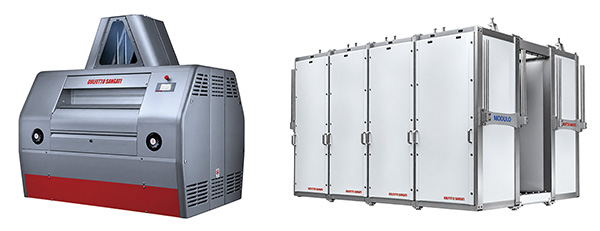
Golfetto Sangati is based in Treviso and manufactures equipment in Italy. Its current portfolio covers soft wheat, durum wheat, maize, oats, and rice, with machinery spanning raw grain cleaning, milling, separation, flour handling, and auxiliary systems.
The company’s Synthesis rollermill is available in two, four, and eight-roll configurations. Its plansifters classify intermediate milling products through stacked sieves, while purifiers separate semolina fractions and cleaning equipment removes unwanted material before grain reaches the main milling stages.
Those machines form part of a process in which no single piece of equipment determines final flour quality. Grain moves through successive preparation, cleaning, conditioning, grinding, classification, purification, and handling stages, with the performance of each affecting what the following equipment receives.
Cleaning takes place before significant size reduction because stones, metal, straw, dust, insects, damaged kernels, and other foreign material create quality, safety, and equipment risks if they remain in the process. Mechanical separation can use differences in size, weight, airflow behaviour, and density to remove those materials.
Satake adds optical sorting to that conventional separation toolbox. Its current portfolio includes systems using colour imaging, shape recognition, and infrared sensing to identify material that mechanical cleaning may not distinguish reliably.
Optical sorting is particularly useful where unwanted material has similar physical dimensions to acceptable grain. Stones, damaged kernels, foreign seeds, colour defects, and other contaminants can require imaging or spectral differences rather than simple screening to separate them consistently.
Once grain reaches the milling section, the process becomes a repeated sequence rather than a single grinding operation. Rollermills progressively reduce particle size and open the grain, while plansifters classify the resulting fractions so that material can be directed to the appropriate next stage.
Purification then separates selected intermediate products further, using combinations of sieving and airflow. The objective is to recover the desired endosperm or semolina fractions while limiting unwanted bran or other material entering the finished flour stream.
The configuration differs between crops. Soft wheat flour, durum semolina, maize products, rice, and oats have different structural properties and finished-product requirements, so the equipment sequence and operating settings cannot simply be copied from one cereal to another.
Raw-material variation adds another layer. Moisture, kernel hardness, protein content, damage, storage history, and contamination all change how grain behaves during cleaning and milling, requiring plants to adjust conditioning and process settings if final specifications are to remain stable.
That is one reason cereal engineering businesses increasingly offer larger sections of the process rather than individual machines. A mill designed around equipment from several suppliers still has to operate as one production system, with material flow, controls, aspiration, dust management, power, access, hygiene, and maintenance considered across the complete plant.
Satake already supplies full plant systems alongside individual machines. Its broader portfolio includes rice-processing plants, wheat and maize milling equipment, optical sorters, analytical equipment, and integrated sorting and processing facilities.
Golfetto Sangati brings a complementary concentration on flour milling. Its equipment range includes rollermills, plansifters, purifiers, scourers, separators, flour control sifters, mixers, pneumatic handling components, and other machinery used from grain intake through finished-product preparation.
The partnership could therefore give the companies a broader combined technical base for future cereal projects, although neither has yet announced precisely how product ranges, sales responsibilities, manufacturing, controls, or service support will be integrated.
That distinction is important. Two large equipment catalogues do not automatically create a better production plant. The engineering value appears only when machines are selected, sized, connected, controlled, commissioned, and supported as a coherent process.
Yield will be one of the principal measures. Milling businesses operate at high volumes, so small changes in flour extraction, off-specification product, energy use, downtime, or by-product recovery can become economically significant when repeated across thousands of tonnes.
Energy is similarly distributed across the system. Grinding, pneumatic conveying, aspiration, cleaning, sieving, and material movement all consume power, meaning optimisation has to consider the complete process rather than reducing energy demand on one machine while increasing it elsewhere.
Food safety and hygiene create another common engineering requirement. Dust control, insect management, cleaning access, sealed product handling, and the removal of foreign material are built into cereal plants alongside the central milling duty.
Golfetto Sangati’s existing equipment includes final flour control sifting before bagging and cleaning machinery intended to remove contamination before milling. Satake’s sorting systems add another inspection layer where visual or infrared characteristics can be used to identify defects.
The 1 October partnership announcement deliberately remains short on project detail. Satake describes it as a strategic step towards strengthening and expanding its cereal business, with the two companies intending to combine technology and knowledge in future activities.
The next meaningful evidence will therefore come from commercial execution: joint orders, integrated plant designs, shared technical platforms, or projects where the two companies’ equipment is specified together.
Until then, the agreement is best read as an expansion of engineering capability rather than the launch of a finished combined system. Satake gains closer access to a long-established European flour-milling specialist, while Golfetto Sangati is aligned with a global supplier operating across a wider cereal, sorting, and plant-engineering portfolio.
For cereal processors, the value will depend on whether that relationship reduces integration complexity while preserving specialist performance at individual stages. Grain still has to move through the same physical sequence; the opportunity lies in making more of that sequence behave as one engineered plant.