IN Brief:
- Kawasaki announced the CP110L North American introduction on 8 October 2026.
- The robot has a maximum payload of 110kg and manufacturer-rated reach of 2,505mm.
- The PACK EXPO demonstration combines boxed dog food and bagged cat food handling.
Kawasaki Robotics is introducing its CP110L palletising robot to the North American market, targeting packaging lines that require a combination of payload capacity and compact installation dimensions.
The 8 October announcement identifies PACK EXPO International in Chicago as the venue for the regional debut, scheduled for 18–21 October 2026. The robot had already been presented internationally earlier in the year.
That distinction matters: the new event is a North American introduction rather than the first global launch of the CP110L or confirmation of a new customer installation.
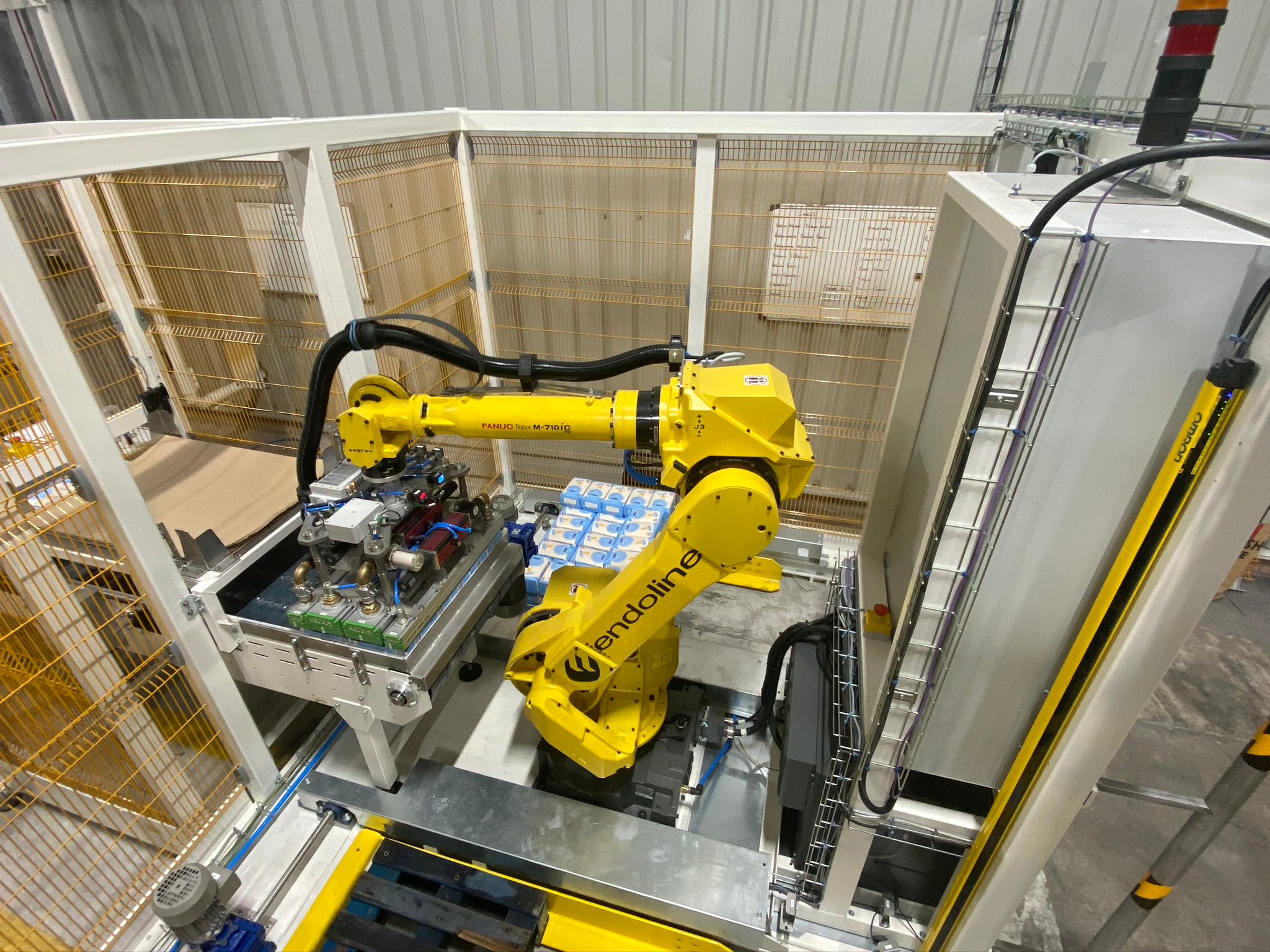
The CP110L offers a maximum payload of 110kg and a stated reach of 2,505mm. Kawasaki positions it as an option for palletising cells where plant layout and available overhead clearance matter.
A maximum payload rating describes the capacity of the robot under its specified operating conditions. The mass of the end-of-arm tooling must also be considered when assessing what products a cell can handle.
Palletising takes finished packs from an upstream conveyor and assembles them into stable loads for storage and transport. The process must be coordinated with packaging-line output and the pallet patterns required by customers.
End-of-line automation can be constrained by limited floor space. Equipment must be positioned so that the robot can reach incoming products, pallet locations and any required empty-pallet supply.
The space needed for an actual cell extends beyond the base of the robot. Operating envelopes, guarding, maintenance access and the route taken by products all influence the installation footprint.
Kawasaki cites a ceiling clearance requirement of 2,242mm and a revolute-axis interference radius of 453mm. These are manufacturer dimensions that need to be checked against the complete proposed layout.
The robot is rated for up to 2,200 cases an hour under defined conditions. That figure should not be treated as a guarantee for every product size, weight or stacking pattern.
Actual throughput depends on travel distance, acceleration, the number of items handled per movement and the timing of changes between full and empty pallets.
Upstream conveyors also matter. A fast robot cannot maintain a high output rate if packages arrive irregularly or require extensive reorientation before handling.
The demonstration will use a custom Piab end-of-arm tool to handle boxed dog food and bagged cat food without changing the tool between the two formats.
This is a significant application choice because rigid cartons and flexible bags have different gripping requirements. A bag can deform under load, while a carton normally retains a more consistent shape.
The gripping system must hold the load securely without puncturing bags, crushing cartons or disturbing product alignment during repeated movements.
Handling varied formats with one tool could simplify some changeovers where the tooling is appropriate to both products, but the supplier has not published measured time savings from the demonstration.
Food and pet-food manufacturers considering such a cell would need to validate the specific weights, pack materials and pallet patterns they intend to use.
Kawasaki has designed a hollow wrist to allow cables and hoses to be routed within the robot structure rather than being exposed in the same way as externally mounted services.
Cable and hose routing affects the reliability of moving systems, particularly where tooling requires electrical connections or pneumatic supplies during repetitive cycles.
Protecting services can reduce certain interference risks, but it does not remove inspection and maintenance responsibilities for the robotic cell.
The CP110L also incorporates regenerative power functionality. It is designed to recover some energy associated with deceleration and make that energy available within the electrical system.
The amount recovered depends on the actual movement cycle. Kawasaki has not supplied a verified energy-saving percentage for a named food-factory installation.
Energy performance should therefore be assessed using comparable operating conditions, including the products handled and the production rate achieved.
Safety assessment is equally important. Palletising robots operate close to conveyors, pallets and sometimes employees who need to replenish materials or respond to faults.
Installations require appropriate access controls, safeguarding, emergency arrangements and procedures for maintenance and fault recovery.
The CP110L forms part of Kawasaki’s wider CP Series of palletising robots. Model selection must consider reach, tooling weight, operating speed and production requirements, not only the largest payload figure.
The Chicago exhibition will also feature other Kawasaki systems, but those should not be confused with the specific CP110L introduction.
No commissioned food-factory installation or verified customer productivity improvement is established by the 8 October announcement.
The commercial test will be whether the machine can meet the required cycle time, pallet quality and reliability within real end-of-line constraints once integrated into a customer operation.